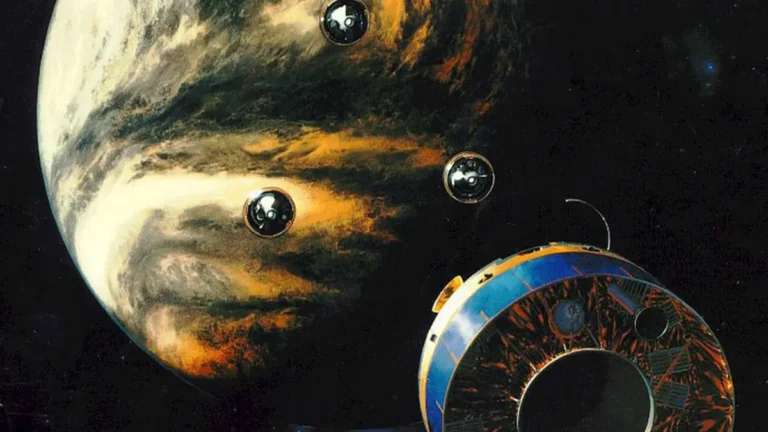
Washington – Global astronomical research groups succeeded in untangling the riddles of one of the most complex atmospheric phenomena across the solar system. The exploration of Venus atmosphere dynamics supplies innovative physical explanations for the first time regarding the twin planet. A team of scholars achieved a detailed and precise comprehension of the dense cloud layers enveloping the scorching planet. The study linked the climatic behavior there with mechanical phenomena observable within fluid dynamics across terrestrial laboratories. Results demonstrated that dense gaseous clouds do not circulate randomly or chaotically as previously presumed during past decades. Gaseous tracks surrender to strict hydrodynamic equations directly impacted by the colossal atmospheric pressure prevailing inside the zone in 2026.
Fluid Motion Experiments Inside Closed Vessels and Explaining Astronomical Vortexes
Astronomers indicated that experimental prototypes deployed on Earth supplied a profound visualization of the cosmic phenomenon. The tests rely on monitoring fluid flows inside closed vessels under precisely governed pressure and temperature environments. The outcomes expose staggering similarities in rotational and clustering behaviors between terrestrial fluids and federal cosmic gases. Venusian clouds materialize within a complex dynamic ecosystem feeding on vast thermal variances among atmospheric strata. These variations trigger ascending thermal currents and continuous rotational cycles that preserve an astonishingly stable profile. The atmosphere circulates at a supersonic speed vastly exceeding the planet’s internal rotational velocity around its personal axis visibly.
The scientific cohort clarified that this mechanical simulation does not imply absolute compatibility between both atmospheric environments. This apparatus operates as a geometric approximation to understand highly complex weather patterns across distant planetary systems. The environment of Planet Venus contrasts radically with Earth regarding density and the toxic chemical architecture of clouds. Clouds there comprise primarily toxic sulfuric acid droplets, alongside suffocating and hazardous corporate gases. However, general physical principles governing fluid dynamics remain collective and constant across diverse spatial corners of the universe. These datasets contribute to developing weather simulation software serving upcoming space exploration expeditions.
Evolving Climatic Models for Companion Planets and Comprehending Geological Transformations
Fresh outcomes contribute to enhancing our comprehension of how runaway greenhouse effects erupted on Planet Venus. This information aids in constructing more precise mathematical models to simulate stormy atmospheres across external exoplanets. The initiative backs international space agency endeavors to design vessels and landers capable of enduring prolonged exposure to harsh environments. Traditional metals melt on Venus’s surface because of temperatures consistently exceeding 480 degrees Celsius regularly. Exploring the terrain mandates a deep grasp of cloud layers to safeguard communication instruments and radars from rapid chemical erosion.
Meteorology experts argue that studying these cosmic phenomena directly services Earth’s climate with great distinction. Comparing diverse atmospheric ecosystems enables evolving prediction apparatuses for hurricanes and acute climatic fluctuations within our lands. Thermal maps secured via space telescopes expose precise details concerning wind interactions with rugged mountainous topography. Academics demand the necessity of intensifying funding for joint research blueprints between astronomers and fluid mechanics engineers.