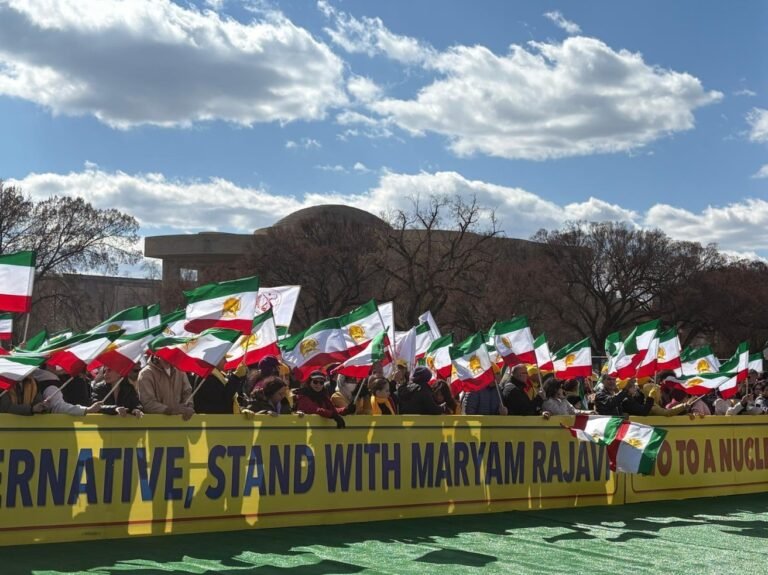
Thousands of Iranian expatriates assembled in the heart of the American capital to amplify the voice of the popular movement opposing the Mullahs’ rule. The current Iranian opposition protests in Washington represent a major escalatory step to highlight ongoing human rights violations in Tehran. Free demonstrators gathered Saturday in front of the US Congress building amid highly stringent federal security measures. Participants protested against the escalation of systematic political execution campaigns and arbitrary detentions inside Iranian prisons. The main platform witnessed broad participation from former senior US military and political leaders in 2026. Opposition leaders seek to extract international recognition of the people’s right to self-determination and building a modern democratic state.
Prominent US Support and High-Level Military Participation to Terminate Dictatorship
Former Supreme Allied Commander of NATO forces, General Wesley Clark, participated in the massive protest event. Former Congressman Patrick Kennedy and Ambassador Carla Sands joined the platform to distinctively back the demonstrators’ demands. Speakers asserted that Middle Eastern stability is directly linked to modifying the aggressive behavior of the ruling regime in Tehran. Maryam Rajavi, President-elect of the National Council of Resistance of Iran, delivered a keynote address via massive interactive screens. Rajavi stated that the velayat-e faqih regime is currently crossing an unprecedented historical impasse internally and externally. The Mullahs failed to contain the destructive impacts of widespread popular uprisings and last January’s massacres across the country.
The opposition leader clarified that the regime escalated its fierce war against citizens through brutal repressive tactics. Current violations encompass prolonged internet blackouts and random vehicle searches across city streets regularly. The regime adopted a “gallows strategy” to convert regional warfare conditions into an opportunity to terrorize political adversaries. Rajavi underscored that raging wars inside the region prove the absence of peace under this terrorist dictatorship. The resistance demands the necessity of enforcing comprehensive international sanctions to isolate Revolutionary Guard commanders and freeze their external financial assets.
The Democratic Revolution and Confronting Appeasement Advocates and Shah Regime Remnants
Rajavi called upon all national forces believing in establishing a secular democratic republic to unite in total solidarity. The political vision of the resistance concentrated on the importance of separating religion from state, guaranteeing party pluralism across the land. She indicated that the Iranian people’s struggle faces backstabbing from two fronts internally and externally with distinction. The first front comprises advocates of appeasing the current regime, justifying its economic and military crimes against neighboring states. As for the second front, it represents the remnants of the defunct Shah dictatorship seeking to restore an unpopular hereditary autocratic rule. She decisively asserted that Iran’s solitary path is the enlightened revolution toward freedom and a bright future.
Rajavi concluded her speech by demanding the international community instantly expel the regime’s ambassadors and agents from Western capitals. She urged global tech organizations to supply free satellite internet to citizens to break the enforced media blackout. Participating women’s conventions believe that Iranian women represent the spearhead in leading the upcoming political transformation. The resistance’s 10-point plan guarantees equal participation for women, safeguarding ethnic and religious minority rights with equity.