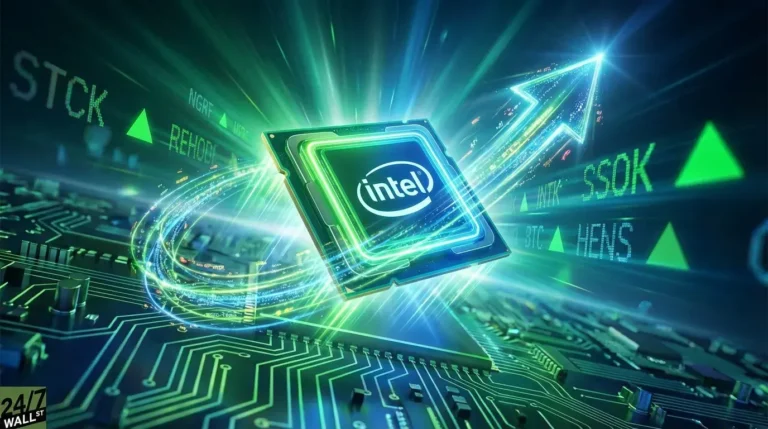
Silicon Valley – Intel has witnessed a strong and sudden return to the forefront of the semiconductor market, sparking widespread debate among tech and investment analysts regarding the company’s ability to reclaim its leadership in an intensely competitive industry. This comeback is driven by rapid strategic moves to restructure production lines and expand investments in advanced manufacturing technologies, repositioning the company to counter the growing dominance of its traditional and new rivals.
This shift has directly reflected on the company’s stock performance in global markets, where Intel recorded a significant improvement in investor confidence after a long period of stagnation and pressure. Observers believe that the current focus on developing chips specifically for Artificial Intelligence (AI) and cloud computing is the primary driver of this growth, as the company seeks to capture a share of markets that now lead the global digital transformation.
Challenging the Giants: Intel vs. NVIDIA and AMD
Intel’s new move represents a serious attempt to reshape its position within the global chip manufacturing ecosystem, especially after companies like NVIDIA and AMD managed to seize large market shares in graphics processing and AI. Through its new generation of chips, Intel aims to prove that its historical leadership can evolve into future innovation, leveraging its massive manufacturing infrastructure and its ability for mass production of advanced silicon.
Experts believe this three-way competition will benefit global technological development, as Intel’s return forces competitors to accelerate the pace of innovation and reduce costs. However, the bet remains on how quickly Intel can close the technical gap that emerged in recent years and its ability to provide power and processing solutions that match those of its competitors in advanced data centers.
The Road of Challenges: Rapid Innovation vs. Traditional Dominance
Despite the prevailing optimism, analysts point out that the road ahead for Intel remains fraught with geopolitical and technical challenges. The global market no longer recognizes the traditional dominance that lasted for decades; instead, it prioritizes rapid innovation and the ability to adapt to the requirements of Generative AI. Intel faces the challenge of balancing the development of its own manufacturing technologies (Foundry) with processor design—a dual strategy requiring massive cash flows and supply chain stability.
In conclusion, Intel’s return to strong competition is one of the most prominent shifts in the tech industry this year. Whether the company succeeds in fully reclaiming its throne or settles for a position as a powerful partner, the roadmap of the chip market has already begun to change, signaling a new phase of technical conflict that will define the next decade of global computing.