Beijing / Washington – The race for dominance over Artificial Intelligence (AI) technologies between the United States and China is escalating at an unprecedented rate, in a scene now described as a “New Technological Cold War.” This rivalry is the primary engine of the future global economy, as both Washington and Beijing strive to control the tools that will reshape strategic power balances, given that AI is the backbone of future industries and a top-tier national security issue.
Washington leads this race through its “Silicon Valley” giants, which are pouring astronomical investments into developing language models and systems capable of autonomous decision-making and hyper-intelligent data analysis. Conversely, Beijing is moving steadily through a comprehensive national plan aimed at making China the world’s leading power in this sector, backed by the world’s largest database and unlimited government support for startups in machine learning and computer vision.
Conflict Extension to Military Industries and Cybersecurity
Tech experts believe that the competition is no longer confined to civilian or economic applications but has extended to sensitive areas such as advanced defense systems and military industries. The transformation of AI into a tool for cybersecurity and surveillance raises international fears of a direct geopolitical conflict, as each power seeks to possess the technical superiority that guarantees control over digital space and protects its infrastructure from potential smart attacks.
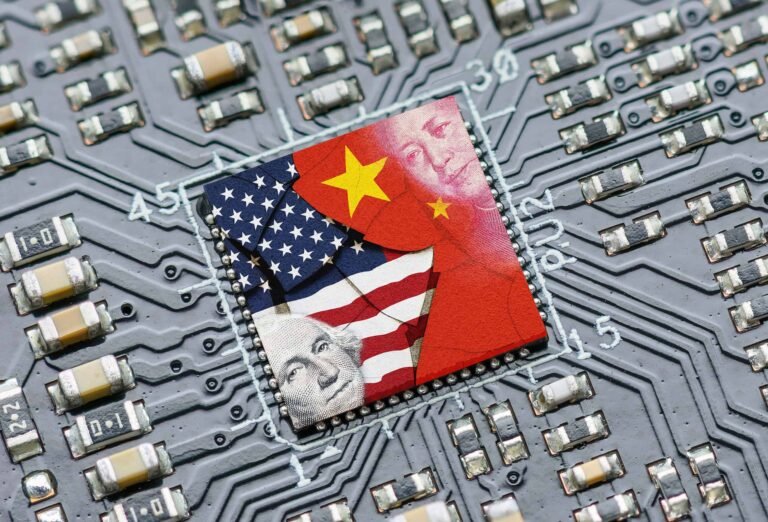
Reports indicate that the technical gap is gradually narrowing; while the U.S. continues to impose strict restrictions on advanced chip exports to hinder Chinese progress, Beijing is succeeding in building sophisticated domestic language models and reducing reliance on Western technology. This technical clash reinforces the idea of “technological decoupling,” where the world heads toward two separate tech ecosystems, one led by the U.S. and the other by China.
Redrawing the Global Economic Map and Lack of International Regulation
Analysts confirm that countries possessing the lead in AI will be the ones capable of guiding the global economy in sectors like medicine, education, defense, and financial services. However, warnings are increasing regarding the absence of clear international regulatory frameworks governing these technologies, which could lead to risks related to privacy and global national security. The race toward “Artificial General Intelligence” (AGI) is moving faster than the ability of international laws to keep pace and regulate it.
In conclusion, the clash of titans between Washington and Beijing over the future of technology remains the most prominent headline of the current decade. Whether this race ends in forced cooperation or a full-scale technical confrontation, the results will determine the identity of the superpowers that will lead humanity in the age of intelligent machines, in a race that seems to know no boundaries and does not recognize second place.