- The arsenal’s recovery and the surprise of Russian missiles
- Details of military operations and exploitation of the truce
- Security analysts say: “Tehran successfully turned the temporary lull into a golden opportunity to reorganize its military and clear its vital facilities.” Reports indicate that many ballistic missiles and launchers were buried under rubble due to the continuous bombardment, which also sealed off access to secret underground storage facilities. It appears that Iran used the weeks of the truce to carry out debris removal operations. It also reopened these vital depots and moved heavy military supplies with ease.
A new report reveals that Iran is bolstering its military stockpiles and developing its capabilities to respond to any potential conflict.
The arsenal’s recovery and the surprise of Russian missiles
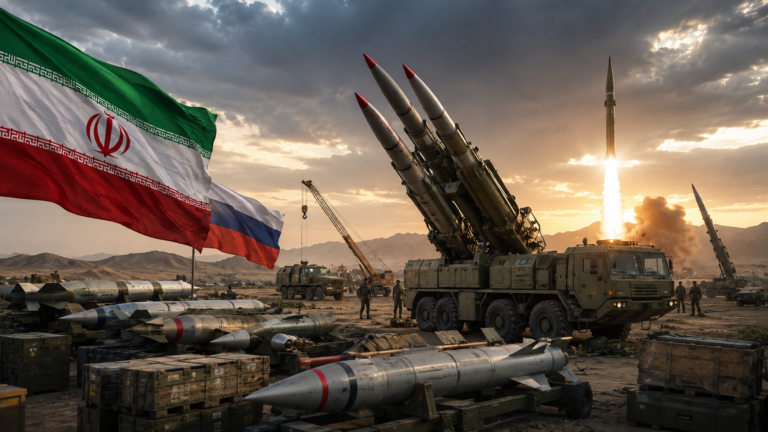
Recent intelligence estimates indicate that Iran now possesses approximately three-quarters of the ammunition and missiles it had before the war. These estimates also confirm Tehran’s considerable capacity to easily replenish this stockpile. This replenished arsenal includes Russian-made missiles, the exact model of which has not been determined. One security assessment suggested that these weapons may have been manufactured within the past year. The Russian Ministry of Defense declined to comment on these reports when contacted by the agency.
This intelligence data contradicts statements made last week by US President Donald Trump, who declared that Iran possesses only 21% to 22% of its missile capabilities. It is also worth noting that previous estimates, released last March, indicated that Tehran retained approximately 60% of its missile arsenal. This is despite the intensive air campaign launched by US and Israeli forces to cripple the Iranian regime’s ability to launch long-range strikes.
Details of military operations and exploitation of the truce
During the period from February 28 to April 8, when the ceasefire agreement took effect, Iranian forces launched more than 1,850 rockets across the region. In addition, Iran launched at least twice that number of rudimentary guided missiles. During the first month of the war, the US and Israel believed they had destroyed approximately two-thirds of Iran’s launch sites. US Secretary of Defense Pete Hegseth stated in mid-March that Tehran’s offensive capabilities had been reduced by 90%.
Security analysts say: “Tehran successfully turned the temporary lull into a golden opportunity to reorganize its military and clear its vital facilities.”
Reports indicate that many ballistic missiles and launchers were buried under rubble due to the continuous bombardment, which also sealed off access to secret underground storage facilities. It appears that Iran used the weeks of the truce to carry out debris removal operations. It also reopened these vital depots and moved heavy military supplies with ease.
Security analysts say: “Tehran successfully turned the temporary lull into a golden opportunity to reorganize its military and clear its vital facilities.” Reports indicate that many ballistic missiles and launchers were buried under rubble due to the continuous bombardment, which also sealed off access to secret underground storage facilities. It appears that Iran used the weeks of the truce to carry out debris removal operations. It also reopened these vital depots and moved heavy military supplies with ease.
On the manufacturing side, the Shahed suicide drone (cruising munition) stands out as a key element in the Iranian arsenal; it is powered by a jet engine and has a range of over 1,000 kilometers (621 miles). These drones are notable for being manufactured almost entirely from readily available commercial parts. Furthermore, the production cost of a single drone does not exceed $50,000.
The agency quoted an informed source, who requested anonymity, as saying that Tehran is capable of continuing to produce new Shahed drones if fiberglass, explosives, smart guidance systems, and engines become available. However, the source indicated that obtaining the explosives might face some relative difficulties as a result of weeks of continuous bombing.
Commenting on the situation, Kelly Greco, a senior fellow at the Stimson Center in Washington, emphasized that the development of new military models would not pose a significant challenge to Iran’s well-established industrial base, which has been fortified even during wartime. She also noted the difficulty of destroying production lines distributed across multiple, fortified geographical locations. Greco added that Iran’s possession of such a high percentage of its previous arsenal makes the decision to resume large-scale attacks a complex and difficult one for Washington and its allies.
For her part, Becca Wasser, head of the defense division at Bloomberg Economics, concluded the scene by saying: “Despite all the tactical successes announced by the United States, it has not succeeded in achieving its strategic goals of crippling Iran’s defense industrial base or significantly undermining its missile program,” stressing that Tehran has shown remarkable resilience and ability to withstand and recover quickly.