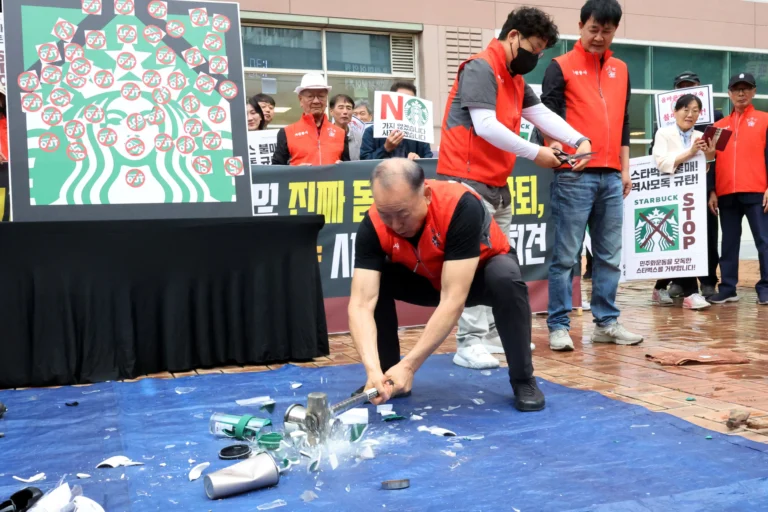
Seoul, South Korea – In a significant international human rights move, 49 human rights organizations representing 25 countries worldwide have demanded the immediate and full release of the findings of the “fact-finding” investigations into the controversial “Tank Day” incident. This incident occurred at Starbucks branches in South Korea on May 18th.
The May 18 Memorial Foundation, in collaboration with dozens of international human rights organizations, issued a joint statement on June 17. The statement stressed the need for Starbucks Korea and its operating partner, E-Mart (Shinsegae Group), to be completely transparent.
The organizations demanded the disclosure of details regarding the decision-making process that led to the launch of this provocative promotional campaign. They also asserted that the current measures fall short of meeting the expectations of the victims and their families.
The statement asserted that the two previous public apologies offered by Chung Yong-jin, chairman of the Shinsegae Group, were merely “formal responses” that fell short of addressing the historical and national offense committed. The human rights advocates emphasized the necessity of a formal and sincere apology in which those responsible explicitly and unequivocally accept full accountability.
The context of the crisis and the sensitivity of history
These demands arose after Starbucks Korea used promotional slogans such as “Tank Day” and “Stop at the Desk” in an advertising campaign for cups. This coincided provocatively with the anniversary of the May 18th Democratic Movement.
These expressions sparked widespread public outrage in South Korea, as the public viewed them as a painful reminder of the brutal military repression carried out by martial law forces during that historic movement. Many also considered them a mockery of the memory of the torture and murder of Park Jong-chul.
Calls for institutional reform
The demands did not stop at an apology; human rights organizations called for the adoption of radical and tangible internal reforms to ensure that such violations are not repeated in the future. They also stressed the importance of including mandatory training and educational programs for staff and partners on historical awareness and human rights principles.
For its part, in an attempt to contain the fallout from the crisis, Starbucks Korea announced plans to hold historical and educational sessions on human rights for its store partners and employees on July 22.
However, it remains to be seen whether these steps will be enough to repair the company’s relationship with the Korean public. The question also remains whether international calls for an independent investigation will push the company toward more stringent and responsible measures.