- Washington downplays the submarine’s significance, while Tehran describes it as an advanced weapon.
- Reverse engineering does not start with the structure.
- Iran does not need to copy the submarine.
- Why does America fear an underwater war?
- Dive-LD: A Weapon or a Warfare Platform?
- Hormuz turns into a laboratory for underwater warfare.
- America holds the upper hand… but Iran possesses the advantage of geography.
- US Submarine Reveals a Larger Battle
- Will submarine warfare begin without submarines?
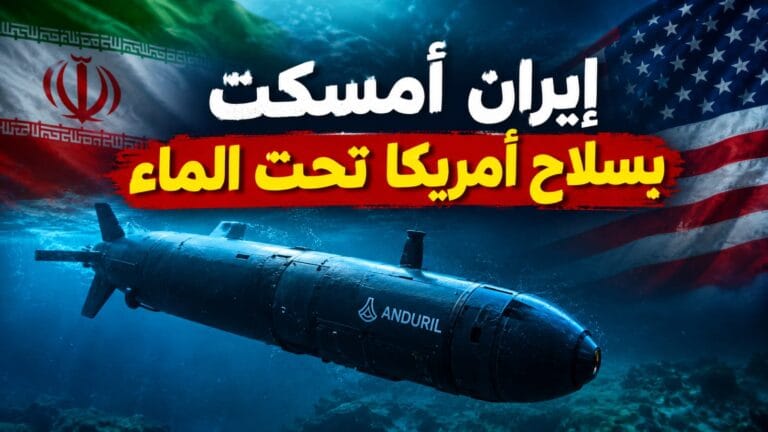
Abu Dhabi, UAE – On September 8, 2026, Iran announced the seizure of an American unmanned underwater vehicle (UUV) at the entrance to the Strait of Hormuz. Iranian media reported that the vehicle was a “Dive-LD” model, developed by the US company Anduril; however, the story does not involve a submarine in the traditional sense, nor does it involve the capture of an American crew. Instead, the asset in question is an autonomous vehicle measuring approximately 5.8 meters in length, capable of executing missions such as seafloor mapping, mine countermeasures, intelligence gathering, and underwater infrastructure inspection. This raises the most critical question: Has Iran acquired an American submarine, or has it gained the opportunity to examine American underwater technology?
Washington downplays the submarine’s significance, while Tehran describes it as an advanced weapon.
The American and Iranian accounts appear contradictory; Tehran presented the vehicle as an advanced U.S. system, hailing its seizure as a military and intelligence achievement. The U.S. side, however, stated that the vehicle had malfunctioned more than a day earlier, noting that it was an older model lacking classified sonar or radar equipment—implying that Washington does not view it as a treasure trove of military secrets. Yet, downplaying the vehicle’s significance does not necessarily mean it is devoid of value; the difference between possessing an image of a military system and possessing the system itself is that the latter allows for the examination of details not always revealed in published specifications.
Reverse engineering does not start with the structure.
If Iran manages to fully examine the Dive-LD, the primary question will not be “How do we build a copy of it?” but rather “How was it designed to function?” The analysis could cover component layout, power management, navigation systems, sensor integration, autonomous control mechanisms, and how the vehicle handles the underwater operating environment. These details may be more significant than the vehicle’s physical form; in modern military systems, reverse engineering does not necessarily entail copying a weapon piece by piece, but rather seeking to understand the system’s operational logic.
Iran does not need to copy the submarine.
The most significant scenario might be entirely different. Iran does not need to produce an exact replica of the Dive-LD to benefit from the vehicle. It suffices for technical analysis to aid in developing methods to detect or disable similar vehicles, understand their operational mechanics, or enhance Iran’s own underwater systems. Here, the process shifts from reverse engineering to counter-engineering; the question is no longer how to manufacture the American weapon, but rather how to render it less effective when it enters Iranian waters.
Why does America fear an underwater war?
Beneath the ocean surface lies one of the most complex battlegrounds; satellites cannot see everything, communications are challenging, and the water conceals the movements of submarines and unmanned vehicles. Consequently, autonomous underwater systems have become a crucial part of the U.S. military race. Projects involving Anduril and the U.S. Department of Defense reveal a growing trend toward autonomous vehicles capable of long-range operations and carrying diverse payloads. This development is unfolding within the broader concept of distributed maritime warfare.
Dive-LD: A Weapon or a Warfare Platform?
The true value of Dive-LD lies in the fact that it is not designed for a single task; according to published specifications, the vehicle can execute missions ranging from reconnaissance, seafloor mapping, and mine countermeasures to the inspection of cables, pipelines, and underwater infrastructure, all while possessing the ability to dive to great depths and operate autonomously for extended periods. This makes it akin to an underwater platform whose mission can be adapted based on the equipment it carries. Consequently, capturing a single vehicle does not necessarily equate to possessing the full capabilities of the American system; however, it does afford the opposing party an opportunity to examine a platform representing a new generation of naval warfare.
Hormuz turns into a laboratory for underwater warfare.
The Strait of Hormuz is not merely a corridor for oil tankers; given its strategic geography and the sensitivity of maritime traffic within it, it serves as an ideal environment for testing a form of conflict driven by drones, unmanned vehicles, and sensors. As unmanned vehicles play an increasingly significant role in U.S. and Iranian reconnaissance operations, the competition may shift from large vessels to whichever side possesses the superior network for underwater surveillance. In this context, any lost vehicle becomes a potential source of intelligence for the adversary.
America holds the upper hand… but Iran possesses the advantage of geography.
The Dive-LD incident does not mean that Iran has achieved parity with the United States in naval technology; a significant gap remains in industrial and naval capabilities, as well as in unmanned systems, sensing, and command and control. However, Iran possesses a factor that American technology cannot negate: geography. Waters near the coast and narrow maritime passages present challenges distinct from those encountered in open-ocean operations. Consequently, Tehran may seek to leverage any knowledge gained from U.S. systems to enhance its ability to counter such technology within its own maritime environment.
US Submarine Reveals a Larger Battle
Even if the American account is accurate—that the Dive-LD was old, inoperable, and carried no classified technology—the incident reveals a broader issue in the era of unmanned weaponry. A weapon that a military can deploy into a dangerous zone because it carries no human crew to be sacrificed can, at the same time, become a source of intelligence should it fall into enemy hands. This represents a new equation in modern warfare.
Will submarine warfare begin without submarines?
The next battle between the United States and Iran might not play out as a confrontation between a U.S. submarine and an Iranian one. Instead, it could involve a network of small vehicles, sensors, drones, unmanned vessels, and counter-systems operating simultaneously. In such a war, the most expensive weapon will not necessarily be the deciding factor; victory may hinge on which side detects its adversary first and can most rapidly translate collected data into action. Thus, the incident involving the U.S. submarine captured by Iran may signify something far greater than the mere seizure of an underwater vehicle; the true battle may already be underway—a contest to see who can learn faster from their adversary’s weaponry.