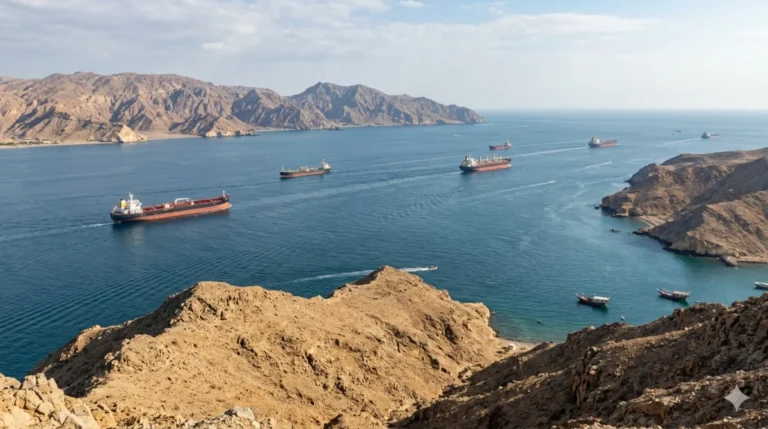
Tehran, Iran – Iran and Oman are nearing an agreement on navigation arrangements in the Strait of Hormuz, as part of efforts to restore commercial shipping through the vital waterway. This comes after months of military tensions that have disrupted shipping in the region. A US official told Reuters that progress has been made in talks between Iran and Oman, adding that Washington expects an agreement on the strait to be reached soon.
Agreement on ship routes
According to reports on the negotiations, the proposed arrangements focus on establishing temporary routes for commercial vessels within the Strait of Hormuz, allowing for a gradual resumption of maritime traffic. Information suggests that Iran seeks to maintain a leading role in regulating shipping traffic through waters within its territorial waters, while Oman would handle the other side of the navigation arrangements. Reuters reported that the proposal grants Iran a role in controlling the movement of ships heading into the Gulf. Meanwhile, negotiations continue regarding the details of the corresponding route.
Dispute over transit fees
The fees that could be levied on ships are one of the points still under negotiation. Oman had previously submitted a proposal, supported by other Gulf states, for a mechanism to manage traffic in the Strait. This proposal includes the possibility of imposing voluntary fees on ships using the waterway. Reports indicate disagreements regarding the amount of the fees and the mechanism for collecting them. Meanwhile, the United States is seeking to ensure the unimpeded passage of commercial vessels without additional fees.
Washington is monitoring the negotiations.
The United States views the reopening of the Strait of Hormuz as part of a broader arrangement to end the war with Iran. A US official said Washington expects an agreement between Tehran and Muscat to be reached soon. Meanwhile, the United States and Iran continue their discussions on issues related to the war, maritime navigation, and sanctions.
Iran links reopening of the Strait to a broader settlement
In contrast, Tehran continues to view the issue of navigation in the Strait of Hormuz within a broader framework than a mere technical agreement with Oman.
Iran seeks guarantees regarding arrangements related to passage, ports, and US procedures. Some details concerning which vessels can use the strait and the mechanism for monitoring maritime traffic remain under negotiation. Previous reports indicated that Tehran rejects a model of joint regional management of the strait and insists on a direct role in managing navigation within its territorial waters.
Bill concerning US and Israeli ships
The negotiations over navigation arrangements coincided with an Iranian parliamentary committee’s consideration of a draft law to prevent American and Israeli ships from passing through the Strait of Hormuz. The draft law is still under parliamentary review and has not yet become law. However, its introduction has added a new dimension to the negotiations concerning the reopening of the strait.
Where have the negotiations reached?
So far, available information indicates progress and initial understandings between Iran and Oman regarding shipping lanes. However, the final details of the agreement have not yet been fully disclosed. The issues still under negotiation focus on:
Ship entry and exit routes.
The role of Iran and Oman in managing maritime traffic.
Potential fees for vessels.
Vessels covered by the new arrangements.
Therefore, the current development is that Tehran and Muscat are nearing an agreement to regulate navigation in the Strait of Hormuz. This does not mean a final announcement of the strait’s complete reopening.