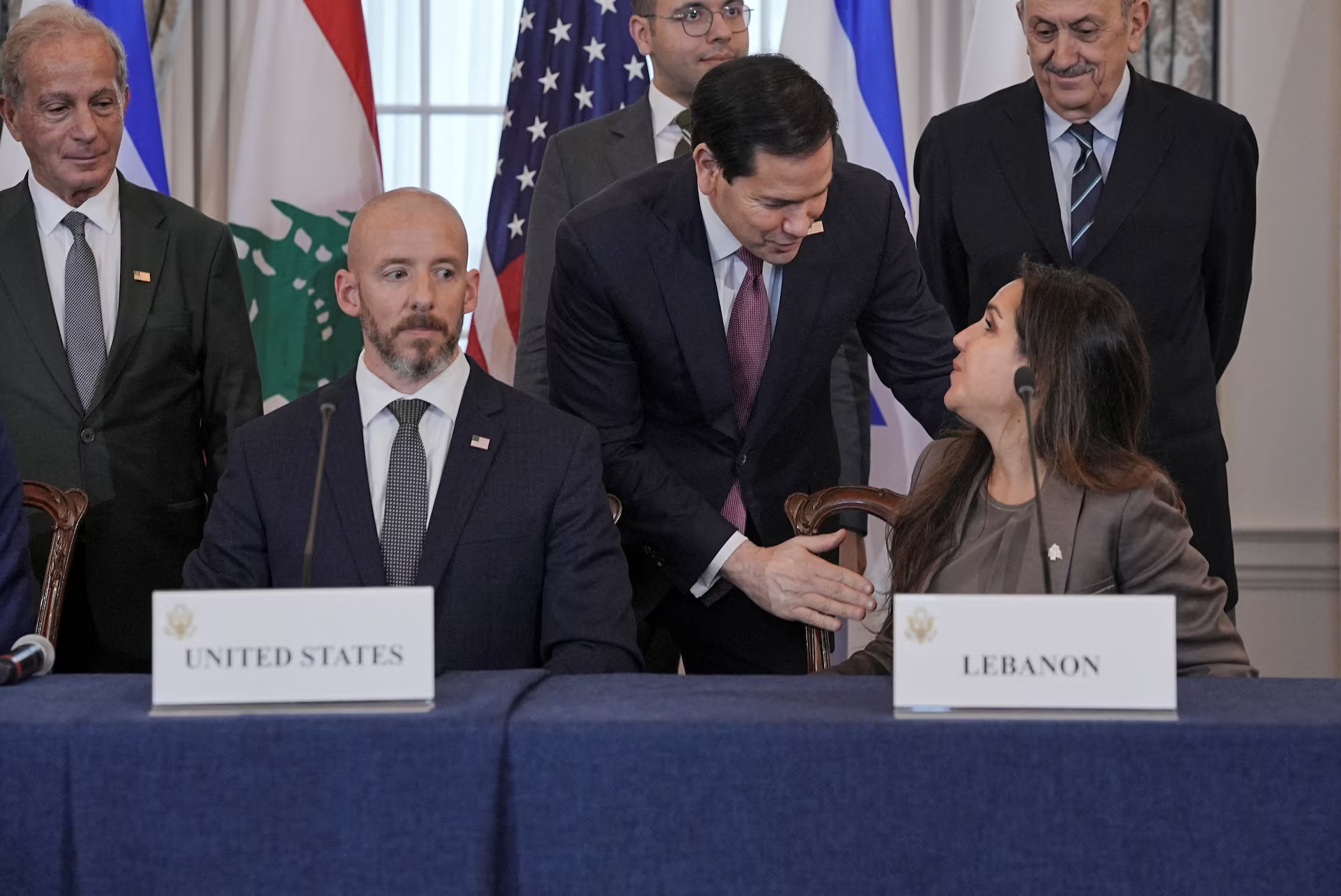
Washington, DC – Members of the US Senate introduced a bipartisan bill called the “Lebanon Sanctions, Stabilization, and Support Act.” Initiated by Democratic Senator Jeanne Shaheen and Republican Senator James Lankford, the bill aims to promote peace. In addition, it seeks to counter Iranian influence, and support the stability and sovereignty of the Lebanese state.
Details of the financial and military package
The project, which aims to build upon the ceasefire agreement and pave the way for a broader settlement, seeks to allocate a wide range of security, humanitarian, and economic measures. These measures include:
Support for the armed forces: Authorization to provide $200 million in annual security assistance to the Lebanese Armed Forces. Additionally, a pathway is available to increase this amount to $300 million annually, provided the government makes progress in confronting Hezbollah.
The precise military allocations include $200 million in foreign military financing, $25 million for counter-narcotics and law enforcement, $11.5 million for counterterrorism and mine clearance, and $3.5 million for military education and training.
Salary support: $20 million has been allocated annually for three years to support the salaries and allowances of members of the Lebanese Armed Forces and Internal Security Forces. This aims to maintain their readiness.
Reconstruction aid: A fund was established to rebuild government services and infrastructure. However, its use is prohibited for the benefit of the “Council of the South.” Additionally, the release of more than half of the funding is contingent upon the US State Department confirming Beirut’s commitment to disarming factions and consolidating weapons under state control.
A strict system of penalties
The bill proposes granting the US president the authority to impose a broad package of sanctions, including freezing assets within US jurisdiction. It also prohibits loans and banking facilities and imposes visa bans and revocations. These measures target any foreign individual providing material support to Hezbollah. Furthermore, they also target those contributing to Iranian funding of armed groups’ activities in Lebanon, obstructing government decisions regarding the state’s monopoly on the use of force, and delaying reforms in the financial and banking sectors.
Monitoring and periodic reports
The new legislation requires the U.S. State Department to submit periodic reports to Congress assessing the Lebanese government’s progress on disarming Hezbollah, implementing banking reforms, and curbing Iranian influence. The reports will also include an assessment of opportunities to improve relations between Lebanon and Israel. Additionally, this includes a review of laws related to boycotting Israel and advancing bilateral negotiations.