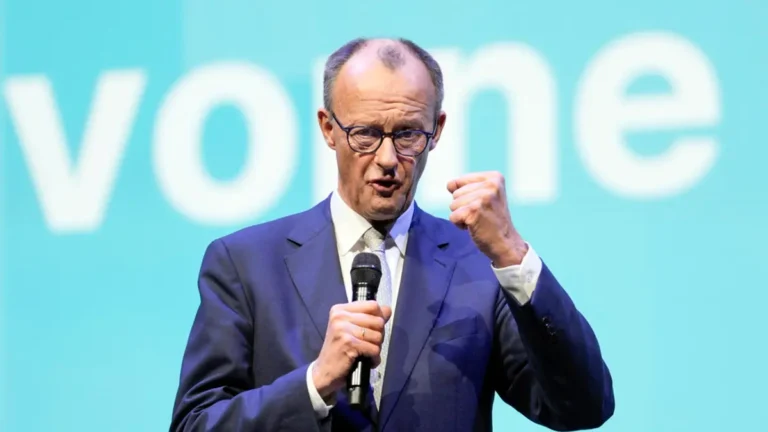
Berlin, Germany – German Chancellor Friedrich Merz is facing mounting political pressure amid growing divisions within his party over his handling of crises. This is fueling widespread speculation about his potential replacement before the end of his term. This controversy reflects an unprecedented state of political turmoil in Germany. Germany is a country long considered a pillar of stability in Europe, according to Politico.
Growing pressures and speculation about change
The German chancellor doesn’t seem to grasp the magnitude of the threats to his position upon returning from his summer vacation. In previous statements, he downplayed the repercussions of the recent party disputes over the cabinet reshuffle, assuming things would calm down by September. However, with crucial regional elections looming next month, and the far-right Alternative for Germany (AfD) party enjoying a strong chance of gaining power in one of the eastern states, the term “Kanzlertausch” (change of chancellor) has begun circulating in political circles. It refers to the possibility of Merz being replaced this fall. While public criticism has primarily come from ministers excluded from the recent reshuffle, quiet discussions are taking place among a growing number of leaders within the Christian Democratic Union (CDU) about this extraordinary scenario. Notably, this scenario arises just over a year after he took office.
The political landscape has changed and stability is shaky.
Germany, with Europe’s largest economy, has long been considered a model of stable democracy, untouched by the rapid changes in leadership seen in Italy or Britain. However, the anticipated decline of the conservative Christian Democratic Union (CDU) and the strong rise of the Alternative for Germany (AfD) party in opinion polls—where it leads with 28% compared to the CDU’s 21%—have dramatically altered the political landscape.
The idea of replacing Merz stems from the conservatives’ desire to contain the fallout from the regional elections and give the party a fresh boost, especially given Merz’s record-low popularity. A recent poll by the German public broadcaster ARD showed that only 13% of Germans are satisfied with their chancellor’s performance. This is the lowest figure in three decades, attributed to his policies on reviving the economy and reforming the pension and welfare systems.
“A palace rebellion” and possible scenarios
The scenario of a “change of chancellor”—in which Hendrik Fuest, the premier of North Rhine-Westphalia, is presented as the leading candidate to succeed Merz—has garnered significant media attention. This is especially true after Der Spiegel magazine dedicated its latest cover to the headline “Rebellion within the Palace.”
Party members fear that the party’s eastern branch might break its historic pledge not to form a coalition with the far right. This could happen should it win the upcoming elections.
Historically, post-war Germany has seen only three instances of a new chancellor from the same political camp assuming power: Adenauer’s resignation in 1963, Erhard’s succession, and Willy Brandt’s stepping down in 1974. If Merz is forced to resign, the least disruptive scenario would be his voluntary resignation. His opponents, however, might resort to a “constructive vote of no confidence,” a constitutional procedure that could lead to the collapse of the ruling coalition and plunge the country into an unprecedented political crisis or early elections. Meanwhile, calls for calm are emerging from across the political spectrum, warning that tearing the party apart from within will only deepen the chaos in Germany and Europe.