- Senate vote on Clayton
- Democrats: Between welcoming the alternative and remaining reserved about the positions
- Who is Jay Clayton? A journey between Wall Street and federal prosecution.
- The administration’s direction and Trump’s vision for downsizing agencies
- The debate over intelligence expertise and political independence
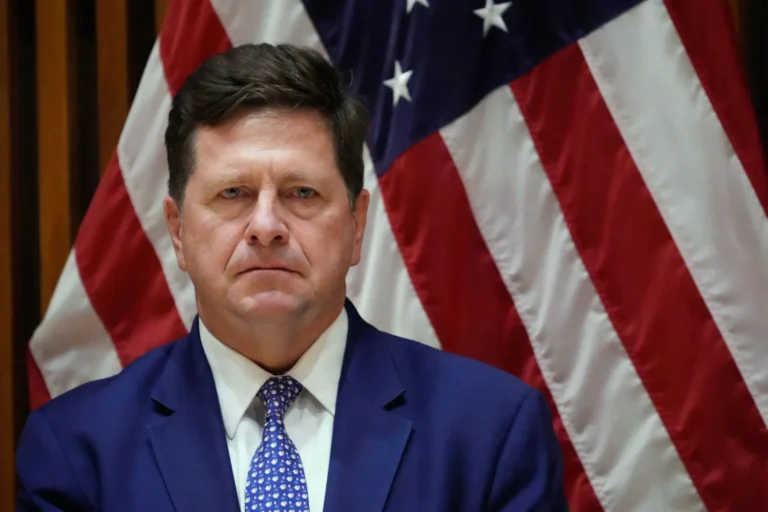
Washington, DC – Jay Clayton, President Donald Trump’s nominee, is on the verge of becoming the next US Director of National Intelligence after clearing the final major procedural hurdle in the Senate on Monday. The crucial step paves the way for a highly anticipated final vote to formally confirm Clayton, amid sharp polarization, significant Democratic opposition, and growing reservations about his background and direct experience in the intelligence field, according to Politico.
Senate vote on Clayton
In its report on the session, the magazine stated that the Senate voted 51-43 to proceed with Clayton’s nomination, paving the way for his appointment as head of the national intelligence community as soon as possible, possibly as early as Tuesday.
No Democratic senator joined the Republicans in supporting Clayton’s nomination, meaning his anticipated appointment to this high-ranking position will be secured solely by Republican votes, a clear reflection of the partisan political divide in Washington.
Once final confirmation is complete, Clayton—currently the top prosecutor in the U.S. Attorney’s Office in Manhattan and former chairman of the Securities and Exchange Commission (SEC)—will assume his new role, succeeding acting Director of National Intelligence Bill Bolt. He will also officially join the cabinet of U.S. President Donald Trump.
Democrats: Between welcoming the alternative and remaining reserved about the positions
Politico viewed this development as a political victory for Democrats, who had sought to replace Bill Bolt since his appointment last month, considering him too close to Trump and completely lacking in any deep background in national security. However, the magazine also noted that the tumultuous confirmation process for Clayton had itself raised new and serious reservations among Democrats about his suitability for such a sensitive position as Director of National Intelligence, reservations clearly reflected in Monday’s vote.
Politico explained that during his confirmation hearing before the Senate committee two weeks ago, Clayton refused to explicitly acknowledge that former US President Joe Biden had fairly won the 2020 election, a stance that prompted Democrats on the Senate Intelligence Committee to vote against his nomination, representing a dramatic shift compared to last June, when Democrats cooperated with Republicans to expedite his confirmation.
Who is Jay Clayton? A journey between Wall Street and federal prosecution.
As the Senate nears its final vote, all eyes are on Jay Clayton, who is poised to assume one of the most sensitive and critical positions in the US administration. Despite this, his long career has been primarily focused on law and financial markets rather than security or intelligence agencies, making his nomination a subject of intense debate in Washington’s political circles. Clayton is married to Gretchen Clayton, a lawyer specializing in compliance and financial oversight, and is known for his relative lack of media attention, having spent the majority of his career in the legal and financial sectors. He earned a bachelor’s degree from the University of Pennsylvania before obtaining a law degree from the same university’s law school. Prior to entering public service, he spent decades working for the prestigious law firm Sullivan & Cromwell, specializing in mergers and acquisitions, capital markets, and corporate governance, providing major legal and financial advice to leading global banks and corporations.
In 2017, President Trump appointed him chairman of the U.S. Securities and Exchange Commission (SEC), where he oversaw the regulation of the stock market. His approach was considered by his supporters to be more flexible and understanding of business practices compared to previous administrations. He also played a pivotal role in initial public offerings (IPOs) and investor protection, and assumed significant responsibilities for market regulation during the period of extreme volatility that preceded and began with the COVID-19 pandemic. In 2025, he was appointed U.S. Attorney for the Southern District of New York (SDNY), one of the most prestigious and established federal prosecutorial positions in the United States. In this role, he oversaw highly complex cases involving terrorism, major financial crimes, corruption, and corporate and financial market violations.
The administration’s direction and Trump’s vision for downsizing agencies
This nomination comes as President Trump announced on Friday his clear desire to shrink the Office of the Director of National Intelligence, explaining that he wants the new acting director, Bill Bolt, to reduce the size of the bureau, which has already been significantly downsized during his second term. Clayton is generally seen as a trusted confidant of Trump since his first term, but he is not considered part of the president’s inner political circle, as his background is primarily in law and finance, far removed from traditional party politics or media work.
The debate over intelligence expertise and political independence
Despite his near-certain appointment to lead the vast U.S. intelligence community, his nomination faced a wave of controversy for two main reasons: First, his lack of direct field or institutional intelligence experience compared to many previous nominees for this sensitive position. Second, his controversial performance during the Senate confirmation hearing, specifically his refusal to explicitly acknowledge Biden’s victory in the 2020 election, stating only that it had been “certified,” as well as his facing tough questions about subpoenas targeting journalists during his tenure as federal prosecutor.
Conversely, Clayton’s supporters staunchly defend him, describing him as a seasoned lawyer and highly competent administrator with extensive experience in handling highly sensitive information and complex investigations. They argue that he possesses the administrative capacity to manage a complex organization encompassing numerous different security agencies. His critics, however, insist that his true expertise lies in law and finance, not intelligence, and that his reserved answers during the Senate hearings raised legitimate questions about his genuine political independence. They also cite ongoing concerns regarding press freedom and the protection of sources in light of some of his recent decisions as a federal prosecutor.