
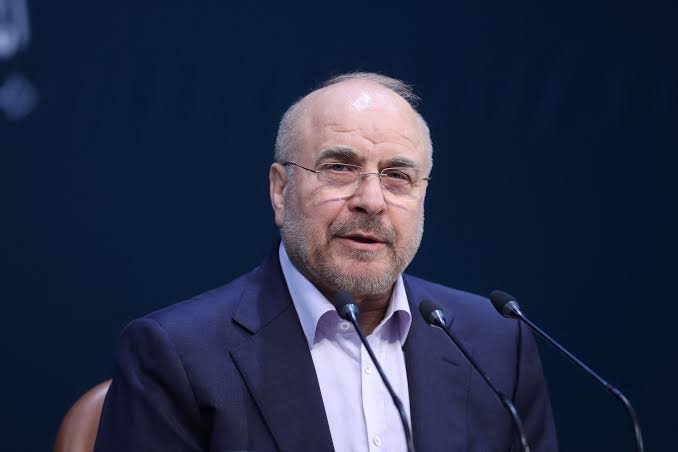
Baku, Azerbaijan – Iran’s chief negotiator, Mohammad Bagher Ghalibaf, asserted that the memorandum of understanding signed between Iran and the United States to end the war in the Middle East essentially represents “a declaration of America’s defeat.”
In a speech delivered at a conference in Azerbaijan and broadcast on Iranian television Wednesday, Ghalibaf emphasized that the agreement was not the result of international pressure or coercion. Rather, it was “the fruit of the courageous resilience, resistance, and determination of the Iranian nation.”
“The end of confrontation and the beginning of interaction”
In a move reflecting a shift in Iranian political discourse toward its regional neighbors, Qalibaf emphasized that the future of the Middle East does not lie in confrontation and conflict, but rather in strengthening interaction among its countries.
He stressed that the countries of the region have the inherent right and direct responsibility to manage their regional security, free from external interference, indicating Tehran’s vision for a new regional security system based on mutual understanding.
Lebanon is at the heart of the negotiations.
Regarding the outstanding issues that must be addressed before a final and comprehensive agreement can be reached with the United States, Qalibaf emphasized the centrality of “peace in Lebanon” as a fundamental and non-negotiable condition.
He explained that Tehran views the issue of a ceasefire in Lebanon with the same strategic importance it attaches to a ceasefire within Iranian territory.
Qalibaf added, “The end of the war in Lebanon is as significant and important to us as the end of the war in Iran.” He emphasized that Lebanese stability remains a fundamental pillar of Iran’s negotiating position, and no agreement with the United States can overlook this crucial issue.
These statements reaffirm Tehran’s commitment to the memorandum of understanding recently reached in the Pakistani capital, Islamabad, which aims to end the widespread military escalation. While international parties are monitoring compliance with this agreement, the Iranian official is sending multiple messages: domestically by emphasizing the “victory of the resistance,” regionally by calling on countries in the region to engage in dialogue, and internationally by linking the fate of the final agreement to several pressing issues, most notably the Lebanese situation.
These statements outline a new phase of “coercive diplomacy” being practiced by Tehran. It attempts to balance its revolutionary rhetoric with the reality of the need for de-escalation, while consistently emphasizing the preservation of its influence and the interests of its allies as an integral part of any future security arrangements in the Middle East.