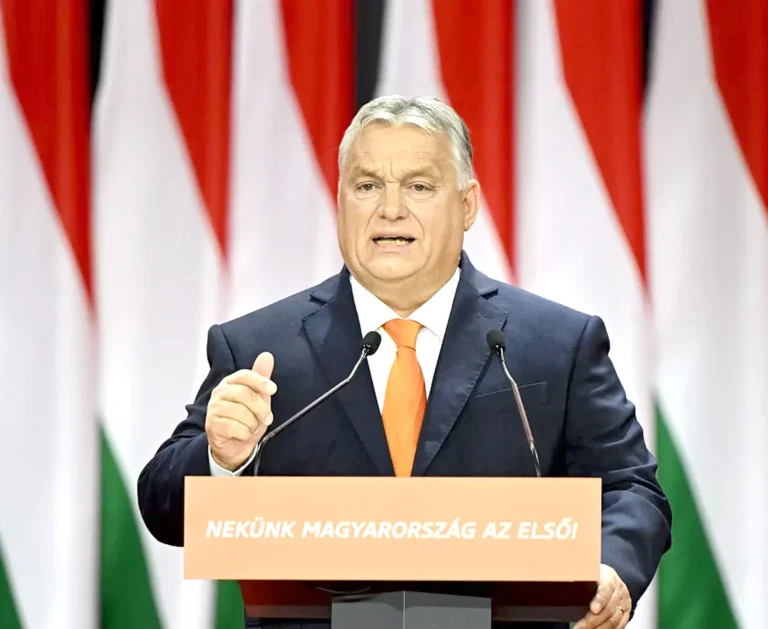
Budapest, Hungary – In a move that underscores his determination to lead his party despite significant political challenges,
outgoing Hungarian Prime Minister Viktor Orbán was re-elected as chairman of the formerly ruling Fidesz party.
Despite the party’s crushing defeat in the parliamentary elections held last April, Orbán secured the confidence of his party members.
He garnered 729 out of 737 votes at the party’s general congress, according to the state news agency MTI.
He vowed to stay despite the election setback
In a passionate speech to the party congress before the vote, Orbán affirmed his full responsibility for the recent electoral setback.
He also expressed his strong determination to move forward, repeatedly declaring,
“I will never give up,” underscoring his commitment to his political path.
The former prime minister acknowledged that Fidesz had enjoyed a “remarkable” 16-year period in power.
However, he emphasized that the current phase necessitates fundamental changes within the party structure.
Plan to shift towards opposition and internal pressures
Orbán explained that the party’s next goal is to transform into an effective opposition force,
capable of regrouping and preparing to return to power in the future.
This shift represents a change in strategy for a party accustomed to holding power for over a decade and a half.
This vote comes at a pivotal moment in the political career of Orbán, 62.
His political future has been shrouded in uncertainty following the recent election defeat.
For the first time since becoming Prime Minister of Hungary in 2010,
Orbán has faced increasing pressure from former allies and close associates, who have openly called on him to retire from politics.
The future of “Fidesz” in light of the changes
This result is considered a test of the strength of his grip on the party,
as it is seen as the first public questioning of his historical leadership since his rise to power.
As Orban turns the page on the electoral defeat, attention is turning to how he will manage the party from the opposition benches.
The question arises: Will he be able to reformulate Fidesz’s political discourse
in order to restore its popular base and overcome the crisis that recently struck its political future?