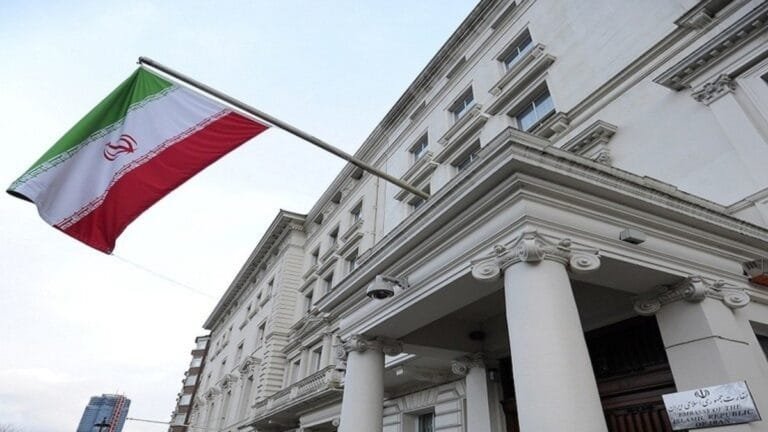
Beirut, Lebanon – Diplomatic relations between Beirut and Tehran have witnessed a sudden escalation of tension and a heated public exchange. This followed a sharp and aggressive response from the Iranian embassy in Lebanon to statements made by Lebanese Foreign Minister Youssef Raji, in which he criticized the nature of the Iranian regime and its regional role in the Middle East.
Iranian Embassy Statement: A strongly worded message to Yousef Raji
In an official statement published on its social media account, the Iranian embassy called on the Lebanese minister to reconsider his assessment of Tehran. The statement read: “Mr. Yousef Raji, do not be mistaken in your understanding and assessment of the Iranian people, the system, and the state that our people love. Be realistic!”
In its response, the embassy added, highlighting what it considered to be internal popular unity in the country: “For more than one hundred days, all the squares throughout our dear and powerful country, which covers an area of 1,648,195 square kilometers, have been overflowing with huge crowds with the participation of all segments of the people, women, men, elders, youth and children, in defense of the Islamic Republic system.”
Statements by the Lebanese Foreign Minister: Tehran is a hotbed of chaos and terror.
This firm diplomatic response came after a television interview given by Lebanese Foreign Minister Youssef Raji to the French channel LCI. During the interview, he launched an unprecedentedly fierce attack on the ruling authority in Tehran. Raji asserted to the media that “the Iranian people are an ancient people with a great civilization, yet for nearly fifty years they have been held hostage by an absolute totalitarian regime that derives its legitimacy from a supposed divine right and does not hesitate to shed the blood of its own people without the slightest remorse.”
The Lebanese Foreign Minister’s criticisms were not limited to Iran’s internal affairs, but extended to Tehran’s foreign policy in the region. Minister Youssef Raji stated unequivocally: “This regime has sown chaos and terror and sown instability in the Middle East and its extensions around the world, and has always been a source of suffering for Lebanon and the region.”
Dimensions of the diplomatic crisis and its critical timing
This direct media and diplomatic exchange between the Lebanese Foreign Ministry and the Iranian diplomatic mission in Beirut signals a new phase of political complexity. It coincides with the Lebanese government’s ongoing efforts to reassert national sovereignty and enforce the rule of law. All of this comes amidst widespread regional anticipation regarding the future of official relations and shared issues between the two countries in the coming days.