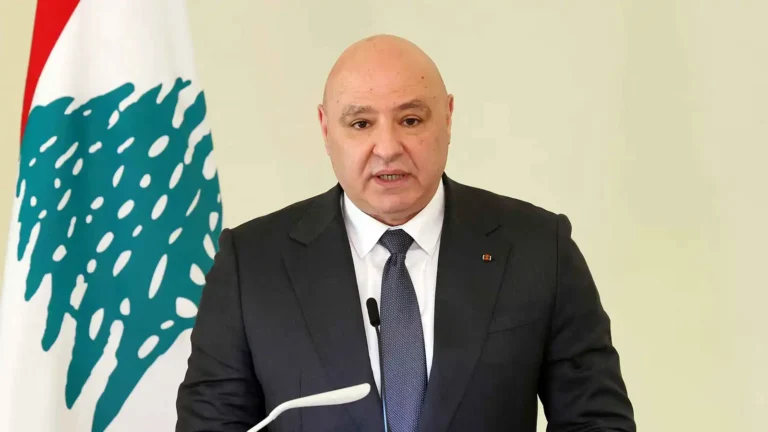
Beirut, Lebanon – On an anniversary of profound national significance, Lebanese President Joseph Aoun affirmed that May 25th will forever be etched in memory as “a day of unifying national dignity.”
In a speech delivered on this occasion, Aoun emphasized Lebanon’s unwavering stance against the continuation of any form of Israeli occupation. He also affirmed that Beirut will not accept any concessions that infringe upon its national sovereignty.
The epic of resistance and the will to liberate
Aoun recalled the epic battles waged in southern Lebanon on this day in 2000, noting that it was the unwavering will of the Lebanese people that forced Israel to withdraw. This was achieved thanks to the sacrifices and resilience of the people over decades.
He pointed out that this anniversary comes today amidst a tense situation on the ground, with Israeli attacks continuing and parts of Lebanese territory still under occupation.
National decision and the extension of sovereignty
President Aoun stressed that a complete Israeli withdrawal is a “firm and non-negotiable national demand.” He also clarified that the Lebanese state is pursuing a path of negotiation to reclaim its rights, rejecting any notion of surrender. This will be achieved in a way that guarantees the protection of the land and the extension of legitimate authority through the military and security forces.
He affirmed that the Lebanese army will remain “the sole guarantor of national security and territorial integrity.” He considered the crucial decisions taken by the state to reflect a unified national will to restore full sovereignty.
A strong state for all Lebanese
In a message to the nation, Aoun asserted that true loyalty to the sacrifices of the soldiers and resistance fighters lies in building a “strong, just, and unified state” based on the legitimacy of its institutions and the equality of rights. He added that liberating the remaining occupied territories is a national responsibility undertaken by the state with the support of its people.
These decisive stances come at a time when the southern front is witnessing a continuous escalation, amid growing international pressure to establish a ceasefire and activate Resolution 1701. This also comes in parallel with intensive regional efforts to prevent the confrontation from expanding and turning into a full-blown war that could undermine the fragile stability in the region.