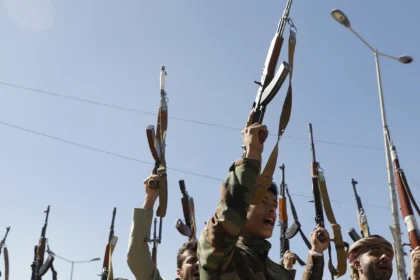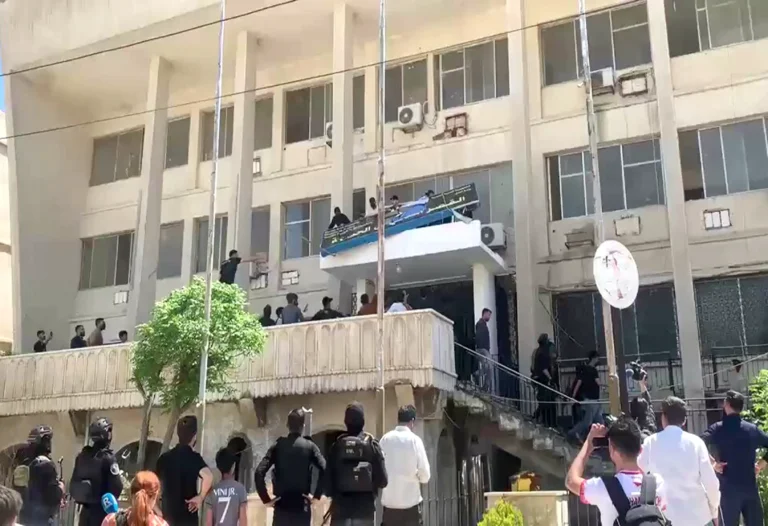
Hasakah, Syria – For the third consecutive day, tensions and protests erupted around the courthouse in the northeastern Syrian city of Hasakah. A number of young people demonstrated
against the exclusion of the Kurdish language from the new sign erected on the judicial building.
The previous sign was only in Arabic, before being removed by the protesters.
Official rejection of acts of sabotage
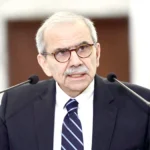
Hassakeh Governor Noureddine Ahmed affirmed that the acts of vandalism
witnessed around the Palace of Justice were unacceptable and detrimental to the public interest.
He emphasized that attacks on public institutions only exacerbate tensions and disrupt citizens’ lives.
The governor urged residents to act responsibly and refrain from any actions that could inflame the situation or spread chaos.
He asserted that public property belongs to all citizens.
Protests against the absence of the Kurdish language
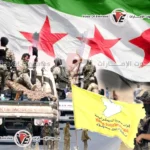
According to local media, a group of young men affiliated with the Syrian Democratic Forces (SDF)
removed the new sign from the top of the Palace of Justice building after it was written only in Arabic.
This followed similar protests last Thursday over the omission of Kurdish from the previous sign,
which included Arabic and English but not Kurdish.
In this context, the Deputy Governor of Hasakah, Ahmed al-Hilali, stated that Kurdish is “a beautiful language and his mother tongue,”
emphasizing his pride in the cultural and ethnic diversity of the province.
legal and political controversy
Al-Hilali explained that the absence of the Kurdish language on official buildings stems from the fact
that Arabic is the sole official language of the Syrian state, according to the constitution and applicable laws.
Kurdish, however, is classified as a national language and is permitted
to be taught in predominantly Kurdish areas as part of educational and cultural activities.
These developments come amidst ongoing tensions in northeastern Syria, despite the agreement signed in March 2015
between Syrian President Ahmed al-Sharaa and the commander of the Syrian Democratic Forces (SDF), Mazloum Abdi.
The agreement stipulated the integration of Kurdish forces into the Syrian army and the handover of civilian and military institutions to the state.
Furthermore, a new ceasefire was reached in early 2016, restoring Syrian government control over large areas in the northeast.