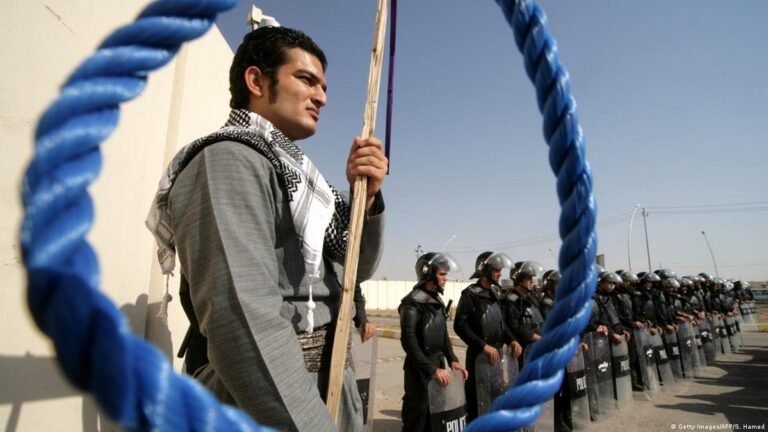
Tehran, Iran – Iranian state media announced on Monday, May 4, 2026, the execution of three people arrested during protests in the city of Mashhad in January of last year.
This move comes amid escalating security crackdowns and a growing number of death sentences against activists and political opponents, which human rights organizations describe as an attempt to intimidate society and prevent renewed unrest.
Details of the charges and victims
According to Tasnim News Agency, which is close to the Iranian Revolutionary Guard, the death sentences against Mehdi Rasouli, Mohammad Reza Miri, and Ebrahim Dolatabadi were carried out. The three men had been arrested during protests that erupted on January 8 and 9, 2015, in the city of Mashhad.
The Iranian judiciary charged Rasouli and Miri with the “direct murder” of security officer Hamid Reza Yousefinejad. Ebrahim Dolatabadi was labeled one of the “leaders of the riots” in the vital Tabarsi district of Mashhad. All three were also accused of collaborating with the Israeli Mossad.
Executions escalate after ceasefire
These executions come at a striking time, as the past few weeks, particularly following the announcement of a ceasefire between the United States and Iran, have witnessed a significant acceleration in the implementation of death sentences.
The list was not limited to those arrested during the January protests. It also included a number of members of the opposition group, the People’s Mujahedin Organization of Iran (PMOI/MEK), who are currently imprisoned in Iran. This suggests that Tehran is seeking to eliminate its domestic opposition as soon as the pressure of the external military confrontation subsides.
International human rights condemnations
Human rights organizations report that Iran, which for years topped the list of countries with the highest execution rates, may now have reached the highest rate of executions per capita in the world.
The organizations assert in their reports that the Iranian regime uses the death penalty as a political tool to instill fear in its citizens and silence any calls for change. They also warned that the continuation of this policy will lead to further grave human rights violations in the absence of fair trials, due to the judiciary’s reliance on confessions extracted under torture.