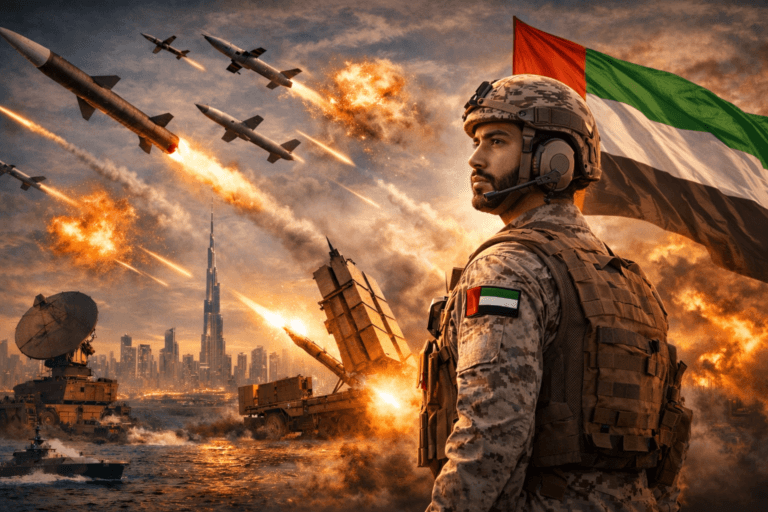
Dubai, UAE – During the recent military escalation, the UAE’s air defenses demonstrated a high level of readiness and efficiency in countering ballistic missiles, drones, and cruise missiles. The UAE reaffirmed that it possesses one of the most advanced and effective air defense systems in the Gulf region. Its air defenses successfully countered complex Iranian attacks involving ballistic missiles, drones, and cruise missiles. This reflects the high level of preparedness the country maintains to protect its airspace and national security.
- A complex attack and a direct test of readiness
- Interception efficiency reflects advanced defensive maturity.
- The ability to contain the threat, not just to counter it.
- The UAE’s air defense is based on a multi-layered system.
- A message of deterrence and confidence in protecting national achievements
- Calm crisis management enhances the state’s image
- Technical and institutional excellence simultaneously
- Summary of the scene
A complex attack and a direct test of readiness
Data related to the recent attacks indicates that Iran relied on a combination of unidirectional attack drones, ballistic missiles, and low-altitude cruise missiles. This attack pattern aims to overwhelm air defenses and open multiple threat paths simultaneously. However, during this escalation, the UAE demonstrated that its defense system is highly effective in dealing with this type of combined attack. It also proved its ability to mitigate the operational and security impact of these attacks.
Interception efficiency reflects advanced defensive maturity.
The Voice Of Emirates News Agency believes that the UAE’s performance in countering the recent attacks was not merely an emergency response, but rather reflects an advanced level of defense built upon years of investment in military technology and the development of early warning systems. Furthermore, improved coordination between monitoring and interception capabilities contributed to enhancing the effectiveness of the response. The announced interception results confirm that the country has not only acquired modern systems, but has also successfully integrated them into an effective operational structure capable of operating under pressure and in complex threat environments.
The ability to contain the threat, not just to counter it.
Analysts told Voice of Emirates that the significance of the UAE’s performance lies not only in intercepting a large number of missiles, but also in containing the threat and preventing it from escalating into internal chaos or widespread damage to the country’s vital infrastructure. The combined attack, by its very nature, relies on creating simultaneous psychological and operational pressure. However, the UAE demonstrated that its capabilities extend beyond military interception to include managing the situation with composure and efficiency. This preserves internal stability and strengthens public confidence in the capabilities of state institutions.
The UAE’s air defense is based on a multi-layered system.
According to Voice of Emirates, the UAE’s success in this confrontation reflects the effectiveness of its multi-layered air defense system. This allows it to address threats according to their nature, altitude, and speed, whether they are ballistic missiles, cruise missiles, or drones. This means that the country has built an advanced defense model over the past years that does not rely on a single method, but rather on an integrated network of monitoring, early warning, and interception. This is why the country was able to mitigate the impact of the recent attacks.
A message of deterrence and confidence in protecting national achievements
Observers who spoke to Voice of Emirates believe that the UAE’s actions in these developments send a clear message: the country is capable of protecting its developmental achievements, vital infrastructure, and airspace. This is happening amidst a highly volatile regional environment. These analyses add that the success of the UAE’s air defenses in dealing with recent threats reinforces the country’s image as a model of strategic readiness, institutional discipline, and effective risk management.
Calm crisis management enhances the state’s image
As Voice of Emirates observes, one of the most prominent aspects of the UAE’s strength during this crisis was its calm and balanced management of the situation. State institutions dealt with the escalation efficiently, clearly, and without confusion. This reflects the UAE’s deep-rooted expertise in managing security crises. The airstrikes do not target only military objectives; they also seek to test the cohesion of the state and the confidence of its society. However, the UAE presented a clear model of preparedness and resilience.
Technical and institutional excellence simultaneously
Analysts told Voice of Emirates that what was achieved in this confrontation cannot be interpreted solely as technological superiority, but also as institutional superiority stemming from the competence of personnel, the speed of decision-making, and the clarity of the defense doctrine. The success of any defense system is not dependent on equipment alone, but on the state’s ability to operate it within a cohesive and effective framework. This is precisely what the UAE demonstrated during the recent escalation.
Summary of the scene
In conclusion, the recent Iranian attacks demonstrate their reliance on attack drones, ballistic missiles, and cruise missiles. However, the UAE has successfully demonstrated its ability to counter these threats through a sophisticated and effective defense system. The Voice of Emirates, believes this achievement reflects a fundamental truth: the nation is committed to establishing a framework based on preparedness, national security, and stability. Furthermore, it is resolutely confronting any threat to its sovereignty or its achievements.