Summary
This summary was generated by artificial intelligence and reviewed by the editorial team at Voice Of Emirates.
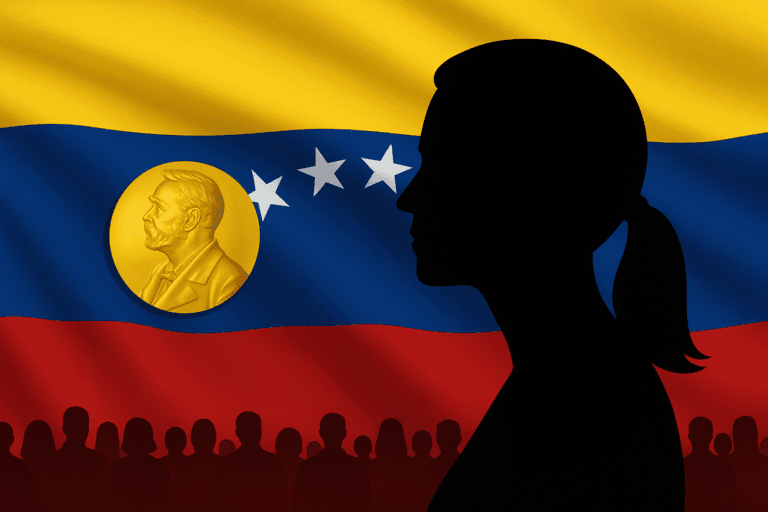
- Maria Corina Machado won the Nobel Peace Prize and became a symbol of the Venezuelan opposition.
- Despite being barred from running, Machado led the campaign for the opposition candidate and successfully rallied support for him.
- Venezuela faces repression and violence after the elections, while Machado operates from a secret location to continue her fight for freedom.
- Machado emerged as a strong leader in the primaries and achieved overwhelming popularity, receiving over 90% of the vote.
- Machado calls for a market economy and the privatization of the national oil company to restore the Venezuelan economy.
Dubai, UAE – Maria Corina Machado, who won the Nobel Peace Prize on Friday, has become a striking symbol of Venezuela’s opposition. This is despite her having lived in hiding since the hotly disputed 2024 presidential election. Edmundo González Urrutia—who stepped in as the opposition’s candidate after she was barred from running—said her award amounts to fair recognition. It is for the long struggle waged by “a woman and an entire people for our freedom and democracy.”
Although the electoral body, accused of bias toward the government, declared President Nicolás Maduro, who has been in power since 2013. The opposition asserted that its candidate was the winner. Machado was not allowed to run after being disqualified. However, she led the campaign behind the scenes for a relatively unknown candidate and succeeded in rallying the opposition around him.
Machado urged her supporters to collect records from every polling station as a means of proving the opposition’s victory. A UN expert mission, however, emphasized that the authorities had responded to the wave of protests. These protests, which followed the elections with repression and violence, have intensified political pressure in recent months. While she chose to remain in Venezuela, González Urrutia was forced to leave the country in September. He left after an arrest warrant was issued against him and he was subjected to harassment campaigns.
In an interview with Agence France-Presse in late September 2024, Machado indicated that she could go weeks without direct contact. She emphasized that she was working where it was most beneficial to her cause. Her battle continued from a secret location. Furthermore, she emphasized that any harm she might suffer would not be a price for compromising the country’s freedom.
A rapid rise and a steadfast motto
Machado’s leadership emerged during the opposition primaries in October 2023, when she consolidated her popularity. She received more than 90% of the nearly three million votes cast. Since then, she has topped the voting intentions. Her supporters have dubbed her “El Liberador,” a reference to the “Liberator” title associated with the historic leader Simón Bolívar. She was known for her outspokenness and vehemence. Observers saw these traits as a key factor in her broad support base. Additionally, she adopted the slogan “to the end.”
After her name was removed from the lists, she became the symbolic nerve center of the opposition. She toured Venezuelan states nonstop, leading her campaign from the streets and in her cars after being banned from air travel. Her rallies attracted large crowds, accompanied by chants and intense emotions.
Contradictory figures and international repercussions
The National Electoral Commission announced Maduro’s victory with 52% of the vote. However, it declined to release detailed results, claiming the reason was a cyberattack. The opposition, on the other hand, released polling station records. It confirmed González Urrutia’s lead with over 67%. The authorities considered the records falsified. Machado’s efforts to compile the records prompted numerous international powers—including the United States, the European Union, and several Latin American countries—to refuse to recognize the official result.
Upon receiving the Sakharov Prize in 2024, she stated that the honor extended to every political prisoner, refugee, exile, and citizen who fought for their convictions. On the economic front, Machado advocates a liberal approach that supports a market economy. She has called for the privatization of the national oil company, Petroleos de Venezuela. Its production has declined sharply due to mismanagement and corruption, according to critics.
She promises to turn the page on the chronic crisis and bring back the millions of migrants who have left the country in recent years. The United Nations estimates their number at around seven million. This is a matter she takes personally since her three children, Ana Correa, Henrique, and Ricardo, live outside Venezuela.
Roots of the political path
An engineer by training, Machado entered the public arena in 2002 by founding the association “Sumati” (Join Us). The organization was created to demand a referendum to impeach President Hugo Chavez. The organization was accused of receiving US funding. The activist also received death threats, prompting her to send her children to the United States. She remained committed to her motto of perseverance until the end.
Politically, her positions have included support for the deployment of US warships to the Caribbean. She believes that Venezuelans are close to regaining sovereignty and democracy. She also asserts that the opposition is ready to assume power whenever the circumstances are right. Between covert action and public positions, Machado is attempting to establish herself as an uncompromising voice for what she considers Venezuelans’ right to change.