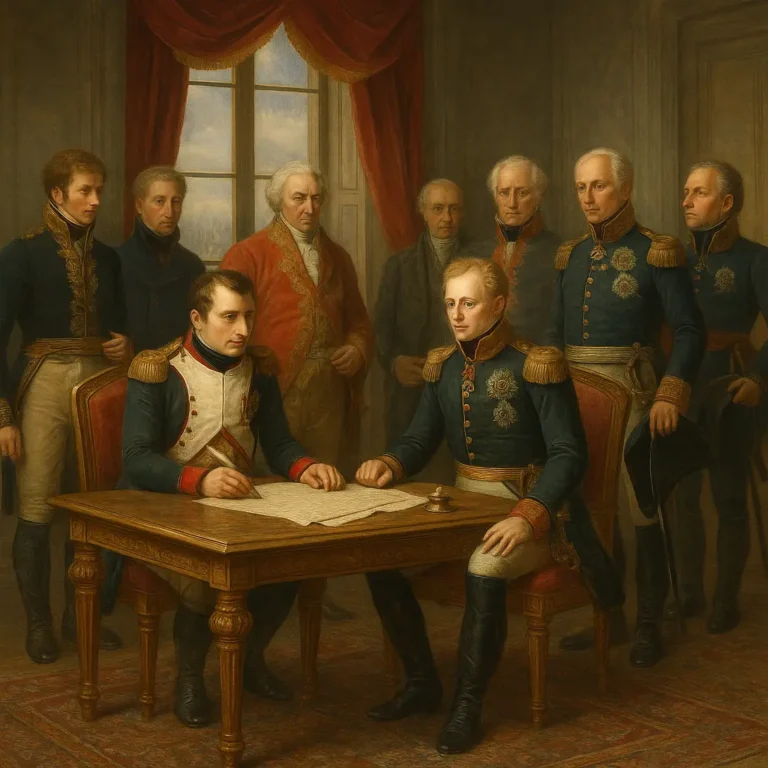
Paris – In an unforgettable historical scene, French Emperor Napoleon Bonaparte and Russian Tsar Alexander I met in 1807 on a floating raft in the middle of the Neman River. That meeting was the birth of the “Treaty of Tilsit,” an agreement that was not just a passing peace, but a diplomatic earthquake that reshaped the map of Europe and established a fragile partnership that eventually turned into a decisive military confrontation that changed the face of history.
Tilsit: From Military Victory to Division of Influence
The treaty was the fruit of Napoleon’s overwhelming victories over the Russian and Prussian armies, announcing the end of a phase of conflict and the opening of a new page of cooperation. The agreement essentially stipulated the cessation of hostilities, the division of spheres of influence in the Old Continent, and Russia’s commitment to join the “Continental System” imposed by Napoleon to strangle the British economy and weaken London’s global influence.
Clashing Ambitions and Contradictory Interests
While France consolidated its absolute influence in Western and Central Europe, Russia gained more space to maneuver in the east of the continent. However, the political “honeymoon” did not last long; Napoleon’s expansionist ambitions collided with the Russian economic reality. The Continental System, imposed by Napoleon, led to a sharp deterioration in Russian trade, creating a deep gap of interests between Paris and St. Petersburg. This economic dispute gradually turned into a political crisis of confidence, paving the way for the collapse of the fragile alliance.
The Road to 1812: The Beginning of the End
As tensions escalated, the spirit of the Treaty of Tilsit vanished, leading Napoleon in 1812 to make his fateful decision to launch his major military campaign against Russia. That campaign was not just a military operation, but a digging of the grave for the French Empire; it ended in a disastrous retreat and heavy losses for the French army. This clash marked a major turning point in the Napoleonic Wars, as Napoleon’s influence began to decline sharply, ultimately leading to his fall and the disintegration of his imperial ambitions a few years after the height of his power.