Bamako, Mali – Mali is experiencing a rapidly escalating security situation following increased military coordination between the National Movement
for the Liberation of Azawad (MNLA) and the al-Qaeda-affiliated group Jama’at Nusrat al-Islam wal-Muslimin (JNIM).
This development poses growing challenges on the ground for the ruling military junta
and threatens to further complicate the security landscape in the Sahel region.
Field alliance against the military council
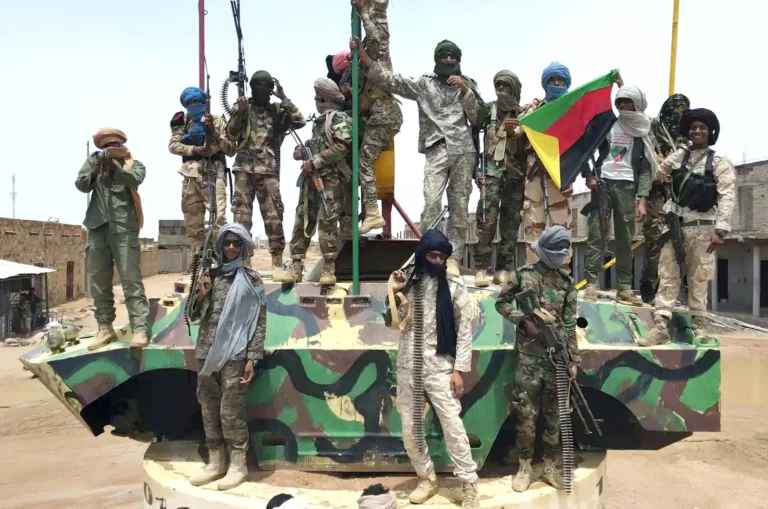
The French newspaper Le Monde reported that the Azawad Liberation Front (MNLA), a predominantly Tuareg group,
and the Jama’at Nasr al-Islam wal Muslimin (JNIM) have overcome years of infighting and are now coordinating military operations
against the forces of the military junta led by General Assimi Goïta and its allies from the Russian Africa Legion.
In recent months, the two groups have launched joint attacks, most notably the operation that resulted in the capture of the city of Kidal.
This was followed by a new offensive in the strategically important Anefis region,
in an attempt to expand their influence in the north of the country.
A reconciliation that ended years of fighting
The rapprochement between the two parties came after tribal mediations led
by notables and sheikhs from the Azawad community since 2024.
The goal was to end the confrontations that broke out between them
following the collapse of their first alliance after the events of 2012.
According to reports, the Front for the Liberation of Azawad accepted
a limited application of Sharia law under the supervision of independent judges.
While the “Support of Islam and Muslims” group agreed to focus
on the financial arena rather than the cross-border agenda.
This helped prepare the ground for military coordination.
Regional repercussions for coastal security
Despite ongoing political differences, the two sides are currently united in their goal of weakening the military junta.
Each benefits from the military expertise of the National Movement for the Liberation of Azawad (MNLA)
and the fighting capabilities of the Group for the Support of Islam and Muslims (GSIM).
Observers believe this coordination could bolster the activities of terrorist groups in the Sahel region.
It also increases pressure on neighboring governments. At the same time, concerns are growing
about the expanding influence of al-Qaeda and ISIS in West Africa, threatening security and stability throughout the region.