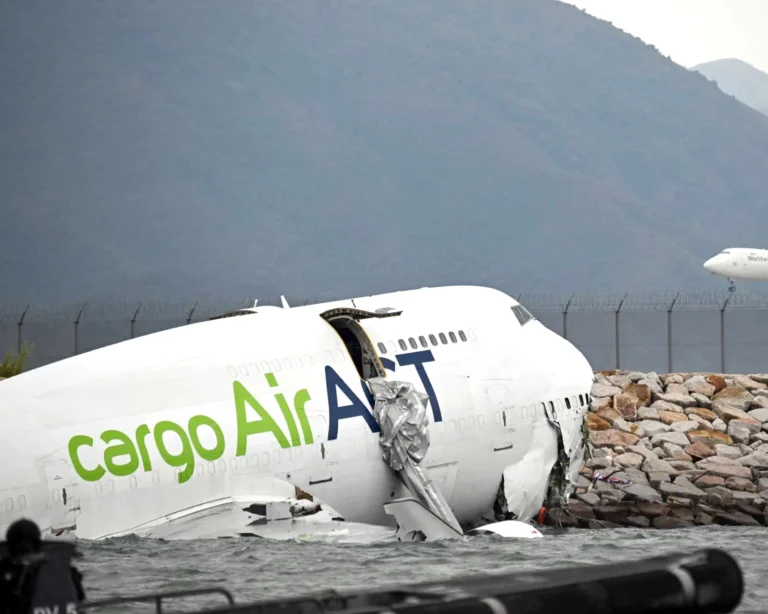
Karachi, Pakistan – In another tragic incident, Pakistani authorities have officially announced the disappearance of a K2 Airways cargo plane from radar screens. This event again puts international focus on Pakistan’s aviation safety record.
The plane went missing while flying over the Arabian Sea off the coast of Karachi.
Search and rescue missions in Pakistan are often challenged by such difficult maritime conditions.
This incident adds to a series of aviation accidents that necessitate a comprehensive review of safety standards.
Clearly, aviation in Pakistan faces important challenges.
The ill-fated aircraft was a Boeing 737-400. It was on a routine flight from Sharjah,
United Arab Emirates, bound for Karachi International Airport.
The final moments before the fall
The Pakistan Airports Authority stated in its official statement that contact
with the aircraft was completely lost when it was approximately
300 kilometers west of Karachi, as it approached the airspace.
The dramatic events began at 9:18 PM local time. At that time, the pilot urgently
contacted the Karachi area control center to report a technical malfunction in the navigation system.
The center responded immediately and provided the necessary guidance to try to secure the flight.
The technical crisis escalated rapidly. At 9:21 PM, radar screens detected alarming movements of the aircraft;
it began descending rapidly and changed course abruptly and sharply.
Following this deviation, all radar contact with the flight crew was lost.
This occurred 155 nautical miles (287 kilometers) west of the coast of Karachi.
Tracking and analysis data
In an effort to clarify the circumstances of the crash, the flight tracking service Flightradar24 revealed details of the final moments.
Efforts are ongoing in both the airline and government authorities across Pakistan to understand what happened.
The service indicated that initial tracking data from the aircraft’s systems showed a turbulent pattern.
This included a sharp loss of altitude, followed by a desperate climb, and then a catastrophic vertical descent.
Flightradar24 added that the last data point recorded the aircraft at an altitude of only 1,100 feet above sea level.
It also recorded a dangerously low vertical rate of 22,400 feet per minute.
Rescue efforts and the formation of investigation committees
Once the disappearance was confirmed, the relevant authorities quickly activated the search and rescue coordination center.
This launched a large-scale maritime search and rescue operation involving multiple civilian and military agencies.
Thus, Pakistan mobilised its resources for this emergency.
The objective was to pinpoint the exact location of the wreckage and locate the crew.
The Civil Aviation Authority announced that the crew consisted of five members.
Amidst this, hopes of finding survivors were slim given the expected speed and force of the impact with the open water.
K2 Airways, the private airline to which the aircraft belonged,
was established in May 2018 and had obtained a license to operate charter flights.
Meanwhile, Pakistani authorities announced that the Air Safety Investigation Bureau would officially assume responsibility
for a comprehensive technical investigation. The aim was to determine the true causes of this air disaster.