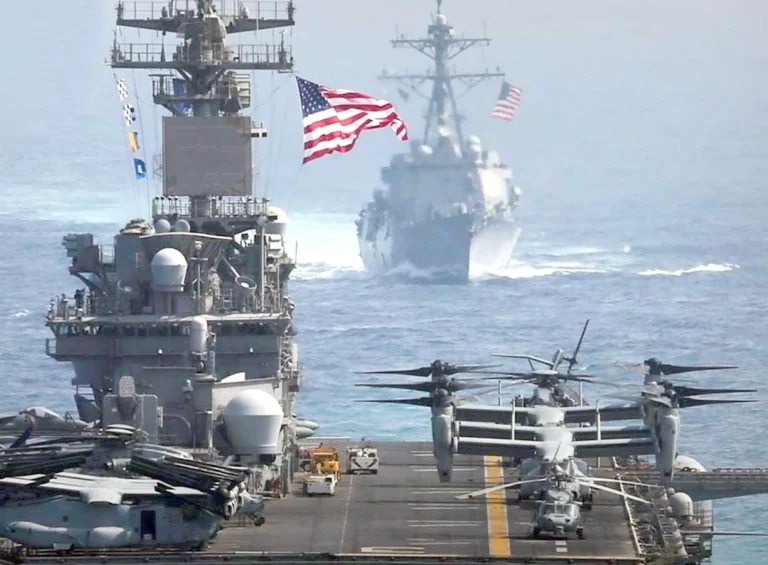
Washington, DC – The US military announced that it intercepted an empty oil tanker in the Gulf of Oman today. This action was part of ongoing maritime surveillance operations conducted by US forces in the region.
Military sources confirmed that the intervention occurred during monitoring of vessel traffic in waterways near the Strait of Hormuz.
The sources indicated that the tanker changed course without any direct confrontation.
Meanwhile, the situation continues to be monitored by specialized naval units under US Central Command.
Details of the incident
Navigation sources explained that the tanker was moving on a regular transit route
before it was spotted by American forces deployed in the region.
According to preliminary information, the ship was not carrying any oil cargo.
This reduces the direct economic impact of the accident.
The sources added that the prevention or redirection process was carried out through maritime communication
and surveillance procedures without resorting to field escalation.
This was done within the framework of the rules of engagement followed in international waters near the Gulf.
Tensions escalate in the region
This incident comes amid escalating tensions in the region surrounding the Strait of Hormuz and the Gulf of Oman.
In this climate, inspections and surveillance operations are increasing intermittently.
Security assessments indicate that these movements are linked to the issue of international sanctions imposed on certain parties.
Furthermore, there are concerns about potential threats to maritime traffic in one of the world’s most important energy shipping lanes.
US forces continue to bolster their presence to ensure freedom of navigation.
The importance of strategic sea lanes
The Gulf of Oman and the Strait of Hormuz are among the world’s most sensitive maritime chokepoints,
through which a significant portion of global oil and gas exports pass.
Washington maintains that its military presence in the region is aimed at protecting international
shipping lanes and deterring any potential threats that could disrupt energy flows.
Meanwhile, several international actors are closely monitoring developments,
concerned that the recurring incidents could further destabilize global energy markets.