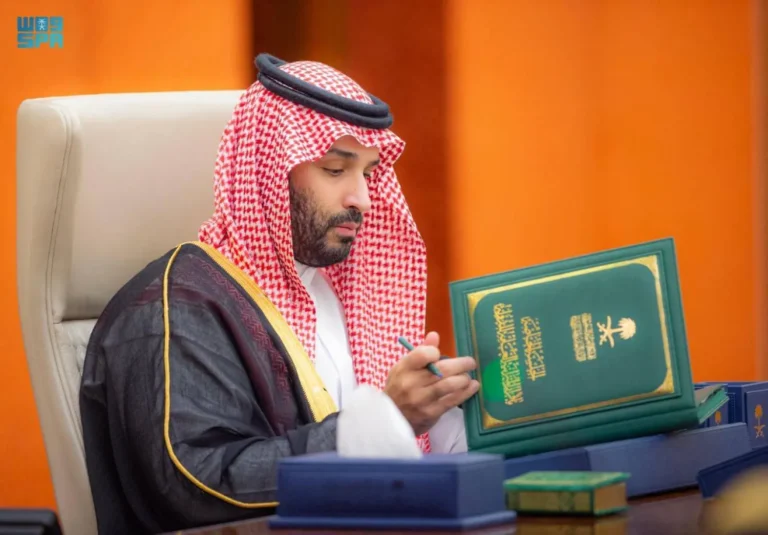
Riyadh, Saudi Arabia – The Saudi Cabinet, chaired by Crown Prince Mohammed bin Salman, approved the Kingdom’s budget for 2026, which targets real GDP growth of 4.6%.
Driven by non-oil activities which continued to play a pivotal role in boosting economic growth at a rate of 4.8%.
The Crown Prince pointed to the structural transformation achieved
by the Kingdom since the launch of “Vision 2030”,
This contributed to improving the growth rates of non-oil sectors,
containing inflation at levels lower than global rates,
and developing the business environment.
Strengthening the role of the private sector to be an active partner in development,
and consolidating the Kingdom’s position as a global economic and investment center.
A deficit of 165 billion
The budget includes a deficit of 165 billion riyals, continuing the expansionary spending policy.
This is to support growth and stimulate investment, especially in large
and transformative projects, according to the Ministry of Finance.
Which confirmed that the return on these projects exceeds the cost of borrowing.
This achieves financial balance and financial sustainability in the medium and long term.
The ministry expects the 2026 budget to record revenues of 1.15 trillion riyals,
compared to expenditures of 1.31 trillion riyals.
With a limited increase in military spending to 240 billion riyals,
and an increase in education spending by 1.5%
It will reach 202 billion riyals, while spending on health
and municipal services will decline by specific percentages.
The projected economic growth in 2026 reflects
a marked improvement compared to 2023 and 2024.
Growth did not exceed 0.5% and 2% respectively,
and also exceeds the expectations of the International Monetary Fund,
which estimated growth at 4% for 2025 and 2026.
Facing global challenges
Crown Prince Mohammed bin Salman affirmed that the government
will continue its flexible and disciplined financial, economic, and social policies.
This is to support sustainable development and ensure the local
economy’s ability to meet global challenges.
While continuing to use sovereign financing tools in accordance
with the medium-term debt strategy.
The 2026 budget comes as part of the Kingdom’s plans
to strengthen the role of non-oil sectors in the economy.
And implementing major projects that will contribute to doubling
non-oil output before the end of the decade.
With a focus on achieving financial sustainability and balanced economic growth.