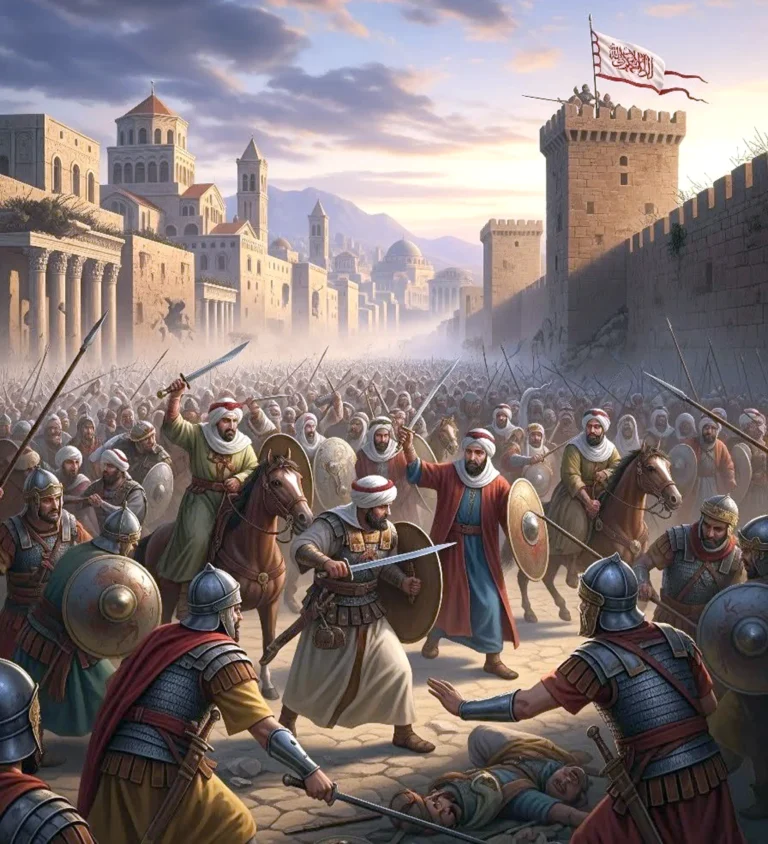
Damascus, Syria – The conquest of Damascus is considered one of the most significant events in the Islamic conquests of the Levant.
Control of the city marked a turning point in the conflict between the Muslims and the Byzantines during the reign of Caliph Umar ibn al-Khattab.
It followed a large-scale military campaign and a siege imposed on the city by the Muslims.
At that time, Damascus was a city of great strategic importance. It was a prominent commercial and military center,
and its location formed a crucial link in the transportation routes connecting the various regions of the Levant.
Beginning of the siege
The Muslim armies reached the outskirts of Damascus after a series of clashes with Byzantine forces.
And the city was besieged from several directions, while the defending forces fortified themselves behind its walls.
The siege continued for some time, and the city experienced increasing military pressure.
Meanwhile, the defenders attempted to maintain their defensive lines and prevent the Muslim forces from breaching the fortifications.
How did the Muslims enter the city?
Historical accounts provide varying details regarding how the Muslim forces entered Damascus,
with some differences between sources.
The most widely accepted account indicates that the Muslims entered from multiple directions.
One point of entry was linked to negotiations, while another involved a military breakthrough.
This ultimately led to the collapse of the city’s defenses.
After the Muslim forces successfully entered, control of Damascus became a reality,
marking the beginning of a new chapter in the history of the city and the region.

Why was Damascus important?
The conquest of Damascus was not merely a fleeting military victory. The city was one of the most important centers in the Levant,
and its capture granted the Muslims a strategically influential position in subsequent military operations.
Furthermore, the city’s fall contributed to weakening the Byzantine presence in the region
and paved the way for further Islamic expansion in the Levant in the following years.
A station in the history of the Levant
The conquest of Damascus was subsequently linked to a series of military and political events.
These events reshaped the region, culminating in major battles such as Yarmouk,
which marked a turning point in the decline of Byzantine influence in the Levant.
Centuries later, the story of the conquest of Damascus remains etched in history books.
It is considered one of the pivotal events that altered the course of the region,
as the city transitioned from Byzantine rule to a new era in its political and cultural history.