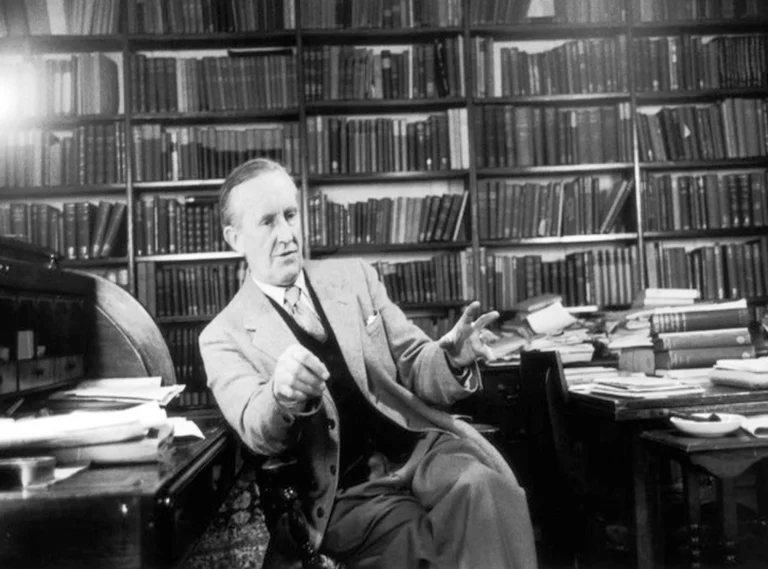
Oxford, England – British author J.R.R. Tolkien occupies an exceptional place in the history of world literature.
He succeeded in creating a complete fantasy world that has become one of
the most famous fantasy worlds of all time, captivating millions of readers worldwide.
Tolkien was born in 1892 and is best known for his works set in Middle-earth,
most notably “The Hobbit” and “The Lord of the Rings.”
He also wrote other works that expanded upon the history, characters, and myths of this world.
“The Hobbit”… the story from which the journey began
The Hobbit, published in 1937, tells the story of Bilbo Baggins, who lives a peaceful life
before finding himself drawn into a perilous journey to retrieve a treasure guarded by the dragon Smaug.
The novel was a huge success. As a result, it became the first introduction
for a vast number of readers to Tolkien’s world and characters.
“The Lord of the Rings”… the work that immortalized his name
Lord of the Rings trilogy became Tolkien’s most famous work, comprising The Fellowship of the Ring,
The Two Towers, and The Return of the King.
story revolves around the One Ring and the attempt to destroy it before it reaches Sauron.
This journey is a tale of adventure, conflict, loyalty, and sacrifice.
novels fame didn’t end with the books. films adapted from them helped bring Tolkien world to a wider global audience.
“The Silmarion”: A History of Middle-earth
The Silmarion takes the reader to a time before the events of The Hobbit and The Lord of the Rings.
It also presents a wide array of myths and legends that explain the origins of Tolkien world, the history of its people, and their conflicts.
The book was published posthumously in 1977. It is based on a large number of his writings,
which were collected and arranged by his son, Christopher Tolkien.
“The Children of Horin”: The tragic side of Tolkien world
The Children of Horin presents one of the darkest tales of Middle-earth,
focusing on the character of Torren Torambar and the struggles and tragedies that surround his life.
The book was published in 2007, drawing on texts and materials written by Tolkien at various stages of his life.
A living legacy
Tolkien’s influence extended far beyond the success of his novels; he played a pivotal role in shaping modern fantasy literature.
He created a world complete with its own history, myths, languages, peoples, and characters.
Despite his death in 1973, his works remain a powerful presence in libraries,
publishing houses, cinema, and popular culture.
His name is synonymous with one of the most influential fantasy literary projects of the modern era.
From “The Hobbit” to “The Lord of the Rings,” Tolkien didn’t simply write fantasy novels.
Instead, he built an entire literary universe that readers continue to revisit generation after generation.