
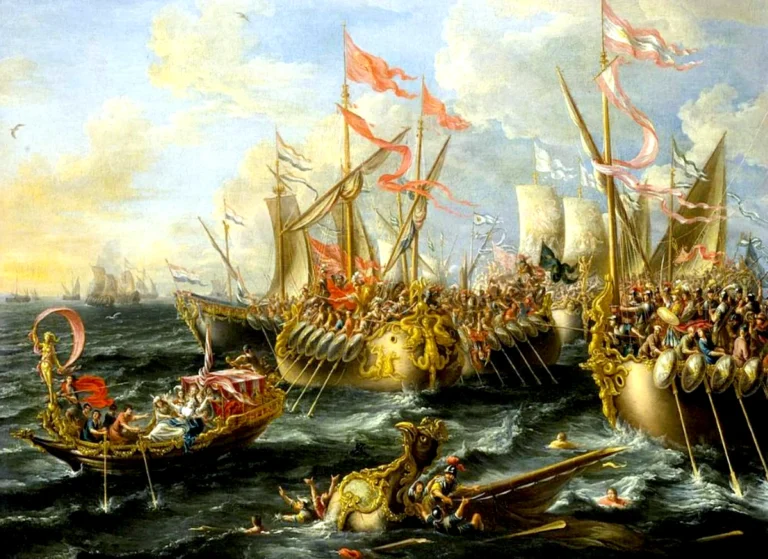
Actium, Greece – On this day in 31 BC, the waters off Actium in Greece witnessed one of the most famous naval battles in ancient history.
On this day, the fleets of Octavian and Mark Antony clashed in a decisive confrontation that effectively ended the struggle for control of the Roman world.
Rome was experiencing a period of political and military division,
as the rivalry between Octavian and Antony had escalated from a power struggle
within the government to an open conflict over influence and authority.
Antony’s relationship with the Egyptian queen Cleopatra further intensified the confrontation.
The growing influence of both men in the East was a source of increasing concern for Octavian.
Large and heavy warships
Antony relied on a massive fleet that included large, heavy warships, along with Egyptian vessels that joined his forces.
Octavian, on the other hand, benefited from the experience of his naval commander,
Marcus Agrippa, in managing the battle and maneuvering in the waters.
At the start of the engagement, Antony’s heavy ships struggled to maneuver and pursue.
This gave Octavian’s forces the opportunity to launch more fluid attacks.
As the fighting intensified, Cleopatra managed to withdraw her ships from the battle zone.
Antony then pursued her, leaving the bulk of their forces behind.
A decisive turning point
This withdrawal marked a decisive turning point. Antony lost the initiative,
while Octavian found himself in a stronger political and military position.
It wasn’t long before Antony and Cleopatra’s resistance completely collapsed.
The following year, Octavian arrived in Egypt. The confrontation ended
with the suicides of Antony and Cleopatra, and Egypt fell under Roman rule.
The effects of the Battle of Actium extended far beyond the battle itself; it redrawn the map of power in Rome.
It allowed Octavian to consolidate his rule, before he was later crowned Augustus and became the first emperor of Rome.
Thus, the Battle of Actium transformed from a naval engagement into a pivotal moment that ended the era of civil wars
and paved the way for one of the longest and most powerful periods in Roman history: the Empire.