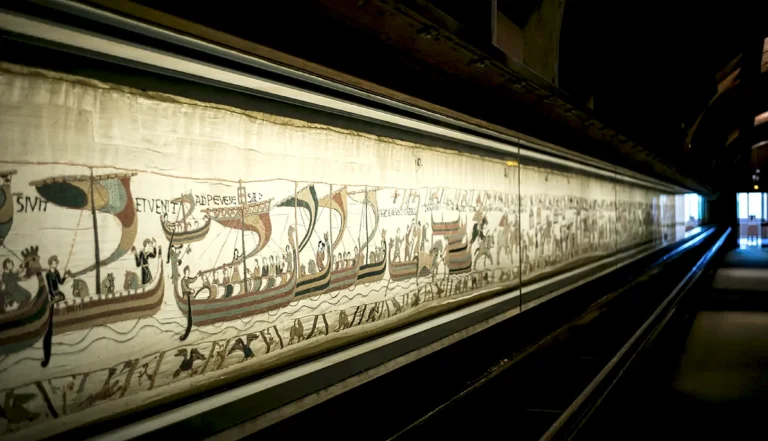
Paris, France – French authorities confirmed that the Bayeux Tapestry, one of the world’s most famous historical treasures, arrived safely in London, where it will be displayed in an exceptional exhibition.
They indicated that the transport was carried out according to the highest standards of protection,
without any damage or impact on the rare artifact.
Those overseeing the transfer explained that the tapestry, which is over nine centuries old,
underwent thorough examinations both before and after the journey.
The results showed that it remains in its stable condition.
This dispelled concerns that had been raised about the possibility of damage
during its transport outside of France.
A unique historical document
The Bayeux Tapestry, measuring approximately 70 meters in length,
is considered one of the most important works of art documenting medieval events.
Its colorful embroidery tells the story of William the Conqueror’s
invasion of England and the Battle of Hastings in 1066.
It is regarded as a unique historical document that combines art and historical narrative.
The tapestry’s loan to Britain comes as part of a cultural collaboration between Paris and London,
following decades of display at the Bayeux Museum in France.
There, it attracted hundreds of thousands of visitors annually
as one of the most prominent symbols of European heritage.
A global cultural event
French officials confirmed that the packing and transport process involved months of planning
and the participation of textile and antiquities restoration experts.
This was to ensure the preservation of the tapestry throughout its journey,
with strict control over temperature, humidity, and vibrations.
The Bayeux Tapestry holds an exceptional place in the hearts of historians and art lovers,
representing a rare visual record of one of the most pivotal events in the history of England and Europe.
It is also one of the most important surviving examples of 11th-century embroidery.
This makes any move or exhibition of the tapestry outside of France a globally significant cultural event.