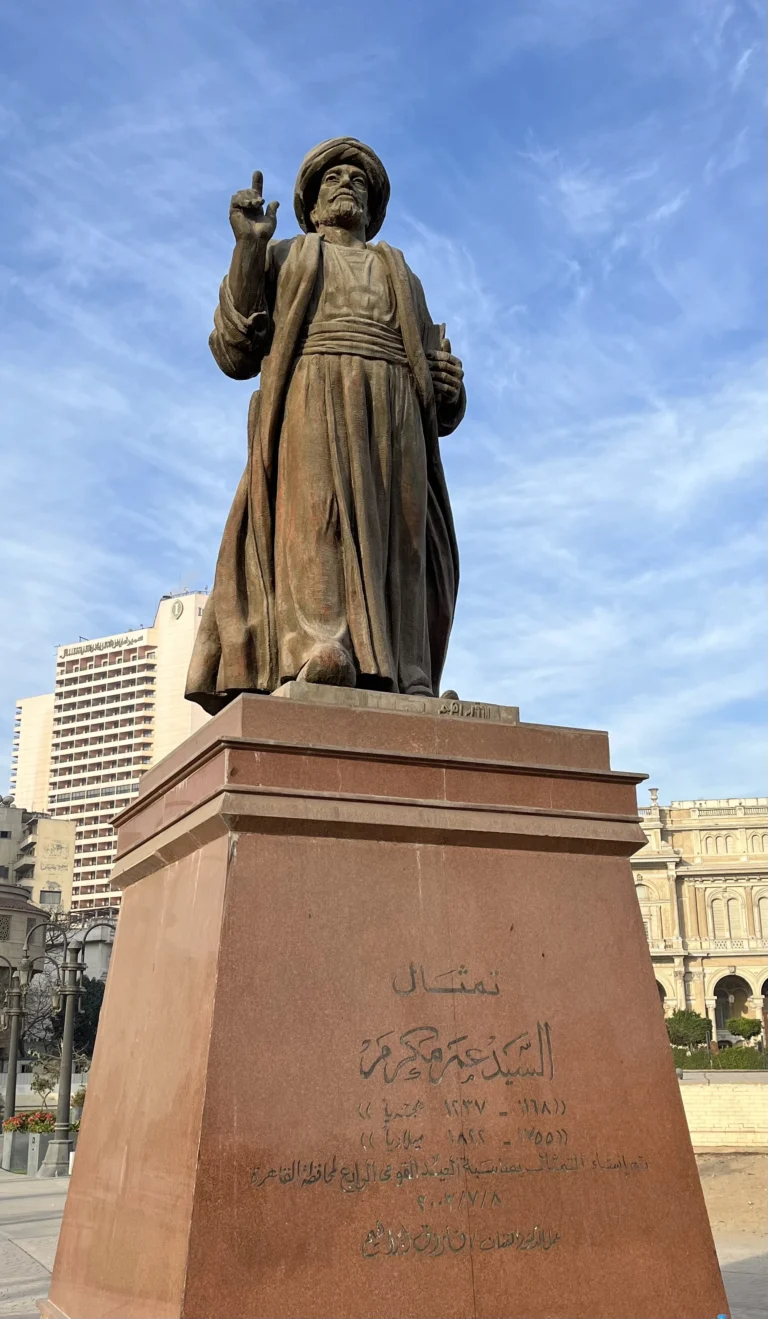
Cairo, Egypt – The journey of the national leader Omar Makram from his birthplace in the Asyut Governorate to Cairo was not merely a geographic relocation; it was the foundational step that paved the way for the rise of one of the most significant figures of resistance and popular leadership in modern Egyptian history. This journey established the roots of the leading role Makram would later play, transitioning from a student of theology at Al-Azhar to the “Naqib al-Ashraf” (Syndicate of the Nobility) and a leader around whom Egyptians rallied during the critical moments of the late 18th and early 19th centuries.
Academic Formation and Leadership Personality
Growing up in a noble Upper Egyptian family, Omar Makram developed a resilient character and a deep sense of pride. He refined his education by moving to Cairo, where he completed his studies at Al-Azhar. Thanks to his extensive knowledge and firm principles, he earned a prestigious status among both scholars and the general public. His rise to the peak of the religious and social scene was no accident; it resulted from the masses’ trust in his strong personality, which never hesitated to stand for the truth, qualifying him for the position of Naqib al-Ashraf—a role that provided him with vast influence and the capacity to lead the masses during times of crisis.
Heroism in the Era of Resistance
Omar Makram’s name emerged as a symbol of popular resistance during the French campaign in Egypt, where he served as a powerful voice and a driver for the masses against the occupation. Following the French departure, his role evolved as a leader of the national movement that sought to fill the political vacuum and establish foundations for fair governance. Makram was the mastermind and the popular will that imposed the decision of the Egyptian people in selecting their ruler, leading the masses to pledge allegiance to Muhammad Ali Pasha as the governor of Egypt in 1805, based on the principle that the legitimacy of governance derives its strength from the consent of the people.
Steadfastness and Challenging Autocracy
Despite the alliance that brought Omar Makram and Muhammad Ali together at the start of the latter’s reign, a divergence in visions quickly surfaced. While Muhammad Ali moved toward consolidating absolute power, Omar Makram represented the voice of popular oversight that rejected injustice and defended citizens’ rights against the tyranny of authority. This principled stance led him into conflict with Egypt’s ruler, eventually resulting in his exile. Nevertheless, Omar Makram’s name has remained immortal in Egyptian collective memory as a symbol of national struggle and a beacon of reform who sacrificed for a better future for Egyptians, proving that true leadership is sustained by the integrity of one’s position rather than the might of power.