Jerusalem, Palestine – History recalls today the anniversary of the First Crusade’s entry into Asian lands in 1097, an event that was not merely a military movement but the onset of a geopolitical and military earthquake that altered the region’s features for centuries. This campaign, launched from Constantinople with Byzantine support, marked the actual beginning of the bloody path that culminated in the fall of Jerusalem to the Crusaders in 1099.
From Constantinople to Asia Minor: The Start of the Incursion
The Crusader crossing across the Bosphorus began in coordination with the Byzantine Empire, which viewed these armies as a tool to regain what it had lost to the Seljuks. Upon entering Asia Minor, the campaign engaged in fierce confrontations, starting with the siege of Nicaea, followed by the decisive Battle of Dorylaeum, which paved the way for Crusader forces to penetrate deeper into the Levant. These initial victories enabled the campaign to overcome its first geographic and military obstacles, providing great momentum for its march toward the Levant.
The Siege of Antioch and Opening the Road to Jerusalem
Antioch posed the major obstacle in the Crusaders’ path, where they faced a long and complex siege lasting several months. The fall of Antioch was not merely a military victory; it was a strategic turning point that turned the city into a secure base for the Crusader armies toward their ultimate destination: Jerusalem. The political divisions and internal wars among regional princes at the time played a significant role in facilitating the Crusader advance, as Islamic powers lacked the unity needed to confront this powerful tide.
The Fall of Jerusalem and Crusader Rule
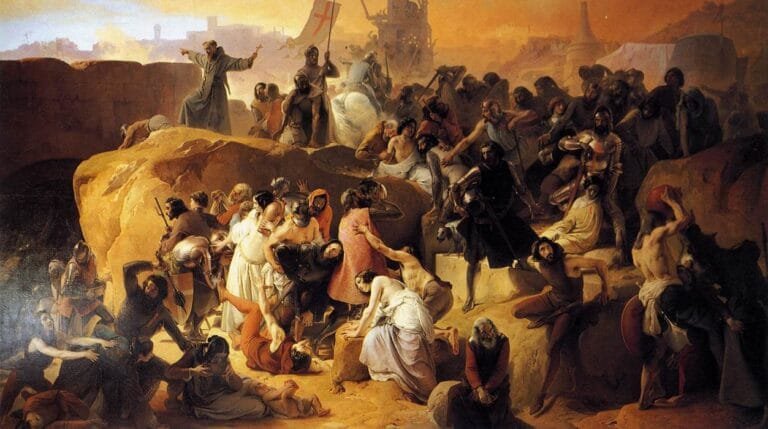
In July 1099, after a fierce siege lasting several weeks, the Crusader armies succeeded in breaching the walls of Jerusalem, beginning one of the most brutal periods in the city’s history. Jerusalem remained under Crusader control for nearly nine decades, during which it became a symbol of the civilizational and religious conflict of the Middle Ages. The city remained under this occupation until the historic turning point led by Saladin in 1187, who returned Jerusalem to Islamic sovereignty following his historic victory at the Battle of Hattin, ending one of the most difficult chapters in the history of the Levant.