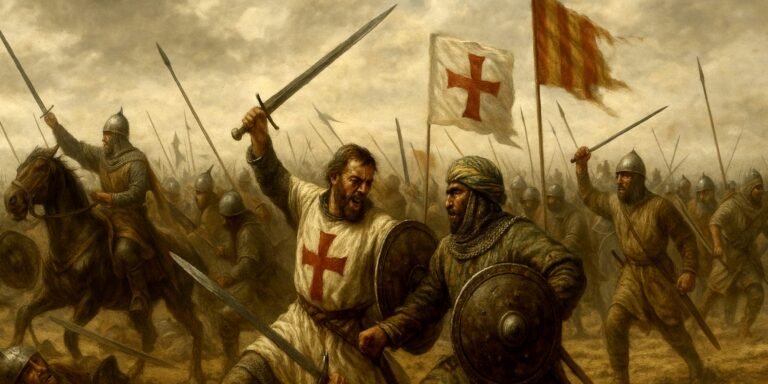
Al-Andalus, Iberian Peninsula – The Battle of Cutanda is considered one of the defining historical milestones that historians link to the major transformation in the path of the Islamic presence in Al-Andalus. It is viewed as one of the defeats that contributed to weakening political and military powers, gradually paving the way for the phase of division and eventual final collapse.
Historical accounts indicate that the battle took place in the context of an escalating conflict between the northern Christian kingdoms and the Islamic forces in the south. That period was witnessing internal disintegration within the Andalusian state and division among the Taifa kingdoms, which weakened the ability to confront repeated attacks.
Political and Strategic Implications of the Battle
Historians believe that the importance of the Battle of Cutanda lies not only in its direct military result but in its political repercussions that contributed to changing the balance of power in the Iberian Peninsula. It gave the opponents of the Muslims a major moral and military boost to continue expanding south at the expense of Islamic cities.
Some researchers also link this battle to a series of successive events that led to the erosion of Islamic influence in Al-Andalus. With the continuation of internal conflicts and the decline of political unity, the Islamic front became more vulnerable to collapse in the face of increasing external pressure.
A Historical Reading of the Reasons for Decline
Conversely, others confirm that the fall of Al-Andalus was not the result of a single battle, but the outcome of long accumulations of political, economic, and military weakness. This was compounded by major regional transformations that Europe witnessed during that critical period of history.
Between multiple accounts and differing interpretations, the Battle of Cutanda remains part of a complex historical record reflecting a delicate phase in the history of Al-Andalus. It was a time where victories mingled with defeats, eventually leading to a radical change in the political and cultural map of the region.