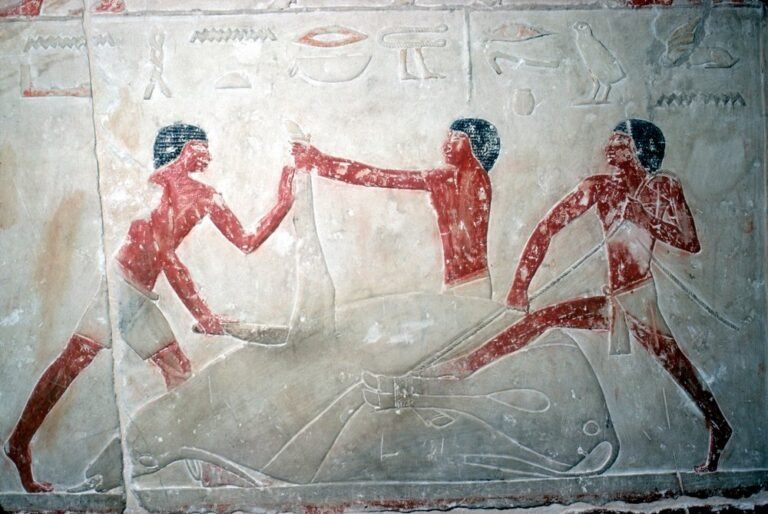
Cairo, Egypt – The concept of presenting offerings in ancient Egyptian civilization was linked to complex religious and social dynamics. Offerings were viewed as a primary means to draw closer to the gods and ensure the continuation of cosmic balance (Ma’at). They also served to protect society from chaos—a belief reflected in various rituals associated with temples and official celebrations. Historical studies indicate that religious practices in ancient Egypt underwent significant evolution across eras. Offerings initially began as agricultural crops and animals. Later, during certain historical periods, they developed into more symbolic rituals inside major temples.
The Debate Over Early “Human Sacrifices”
What is occasionally raised regarding the existence of human sacrifices during some early stages of ancient Egyptian history remains a subject of debate among researchers. There is no conclusive archaeological evidence confirming that these practices were a fixed or widespread religious system. Instead, most Egyptologists suggest that the rare documented cases were associated with conflicts or exceptional circumstances in very early periods. This was before the stabilization of the centralized state. As the state evolved, religious rituals shifted toward greater organization and symbolism. Eventually, they were presented within celebratory contexts tied to agricultural seasons and religious feasts to express gratitude and ensure blessings like the Nile flood and prosperity.
Temples as Administrative and Economic Hubs
Temples played a pivotal role in managing these rituals. They served simultaneously as economic and religious centers that received offerings. In addition, temples redistributed a portion to priests and workers. This transformed the practice into an integrated system combining religion, administration, and economics. It is worth noting that the concept of an offering in ancient civilizations was not always tied to the modern meaning of “Qurbani” or ritual slaughter. Rather, it carried broader connotations involving the equilibrium between humans and the divine world.
Intellectual Shifts Paving the Way for Future Civilizations
Historians believe that the evolution of the concept of offerings throughout history reflects intellectual shifts in ancient societies—moving from practices reliant on direct material sacrifices to more symbolic and organized forms. This later paved the way for the emergence of different religious concepts in subsequent civilizations. While the subject of offerings in ancient Egypt remains an area of ongoing research, it opens a window toward a deeper understanding of how the earliest religious beliefs were shaped and mirrored in social and cultural practices.