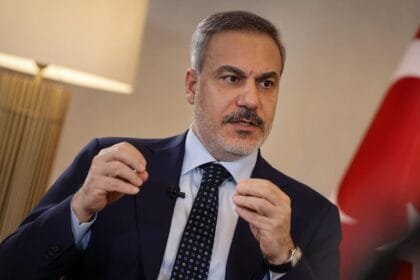

Researcher and political analyst Tariq Abu Zeinab believes that US President Donald Trump’s decision to suspend “Operation Freedom” in the Strait of Hormuz cannot be considered a retreat.
Rather, it is a calculated tactical move that combines pressure on the ground with opening avenues for negotiation.
Abu Zeinab explained that Washington, despite its military superiority,
chose to temporarily halt operations while maintaining the naval blockade.
This is to test the seriousness of Tehran’s commitment to engaging in a comprehensive agreement.
Gulf-American move at the Security Council
According to this analysis, the current US strategy relies on “calculated escalation followed by conditional de-escalation.”
This aims to impose strong negotiating terms without sliding into a full-blown war that could jeopardize global energy security.
The fundamental question remains: Will Iran seize this opportunity, or will it misinterpret
it as a sign of weakness? This could quickly return the region to a cycle of escalation.
Abu Zeinab revealed a parallel diplomatic move, with Washington distributing
a draft resolution to members of the Security Council.
This draft was formulated in coordination with the Gulf Cooperation Council (GCC) states.
He indicated that the draft includes clauses that hint at action under Chapter VII of the UN Charter.
This opens the door to imposing stringent international sanctions,
or even using military force, should Iranian threats to commercial shipping in the Strait of Hormuz persist.
The objectives of the aggression
In his analysis of the attack on the Emirati oil tanker, Abu Zeinab asserted that the incident was not isolated.
Rather, it is part of a systematic regional pressure campaign aimed at:
Sending a deterrent message to the Gulf states to dissuade them
from aligning themselves politically and in terms of security with the United States.
Exerting direct pressure on the UAE, given its status as a global strategic and economic hub for trade and energy.
Creating crises in waterways to strengthen Iran’s negotiating position in any future settlements.
The UAE ranks first globally in stability
Despite these challenges on the ground, Abu Zeinab clearly points out
that global confidence in the UAE economy remains steadfast and unshaken.
The UAE has successfully secured the top spot globally in “Economic Stability” for 2025/2026,
surpassing major economic powers such as Switzerland, Germany, Canada, and Japan, according to the U.S. News & World Report.
This success, according to Abu Zeinab, is based on solid structural foundations:
Exceptional diversification: More than 77% of GDP is derived from non-oil sectors.
Formidable financial strength: Banking assets exceeding AED 5.47 trillion,
within one of the world’s strongest financial environments.
Sovereign influence: Three of the world’s largest sovereign
wealth funds (Abu Dhabi Investment Authority, Mubadala, and ADQ) are among the top ten globally.
Dr. Tariq Abu Zeinab concluded his statement by emphasizing that these results are not a coincidence.
Rather, they are the product of an economic model that transforms challenges into growth opportunities.
This proves that the UAE is the one “creating stability” in a world full of changes.