Dubai, UAE – The Worldiff Dubai 2026 Forum concluded its activities at Dubai Commerce.
Bringing down the curtain on an extraordinary session held under the patronage of His Highness Sheikh Ahmed bin Saeed Al Maktoum, Chairman of the Dubai Integrated Economic Zones Authority “Dies”.
This comes after three days of high-level strategic discussions that reflected the maturity of the global movement in the digital commerce sector.
The session, hosted by Dubai for the second time, brought together more than 18,000 visitors and elite decision-makers, entrepreneurs, investors and experts from more than 80 countries.
It confirmed the growing momentum witnessed by the digital trade system in Dubai and the region, and the emirate’s location enhances a global platform for dialogue and formulating future directions for the digital economy.
The second and third days of the forum featured a series of qualitative sessions focusing on the future of digital commerce and its integration with artificial intelligence, cybersecurity, supply chains, and cashless payments solutions.
In addition to anticipating the prospects of cross-border trade over the next decade, in light of the rapid transformations taking place in the global digital economy.
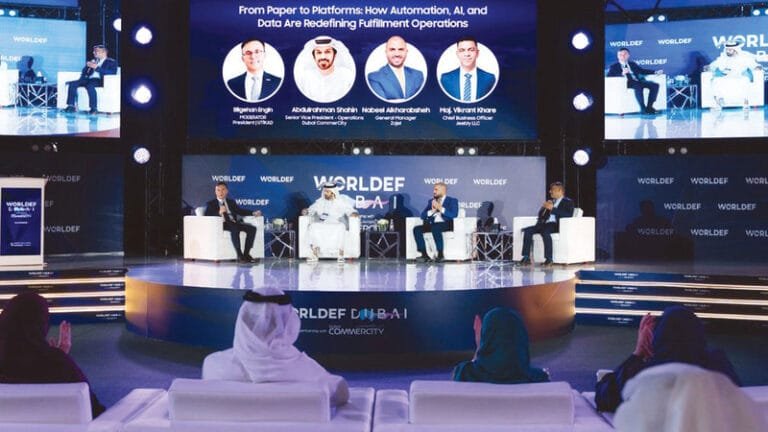
At the level of specialized sessions, a session entitled “From Paper to Digital Platforms: How Automation, Artificial Intelligence, and Data Are Reshaping Implementation and Supply Processes” highlighted the role of advanced technologies in redefining supply chains and logistics services within an rapidly growing digital trade environment.
This was attended by Abdulrahman Shaheen, Executive Vice President of Operations at Dubai Commerce, Vikrant Kari, Chief Business Officer at Ghibli, and Nabil Al Kharabsheh, General Manager of Zagel.
Participants emphasized that automation contributes to reducing human errors and increasing operational efficiency.
While predictive analytics allows for path optimization and reduced delays at various stages of the supply chain.
They also stressed the importance of integration between the public and private sectors to support modern logistics systems.
In addition to investing in developing human resources skills as a fundamental pillar in the transformation process.
Noting that sustainability has become directly linked to improving efficiency and reducing operational waste.