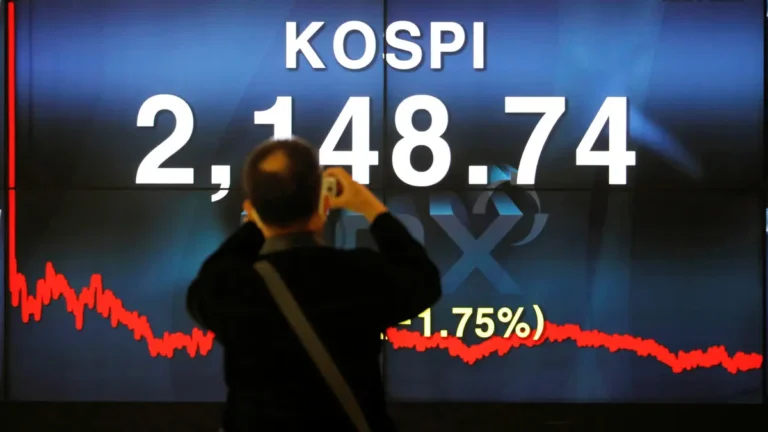
Seoul, South Korea – South Korea’s stock market experienced a turbulent day of sharp fluctuations, with the benchmark KOSPI index plummeting. This decline was driven by a wave of heavy selling led by global funds.
These developments come as international institutions begin to reduce their positions in one of the world’s most active and dynamic stock markets, raising concerns about the sustainability of the market’s record-breaking rally since the beginning of the year.
Session drama and the technology sector
Trading began on an optimistic note, with the index briefly touching the 8,000-point mark early Friday morning. However, these gains quickly evaporated, as the Kospi reversed course to close down nearly 7%.
The technology sector was the biggest casualty of this downturn, as foreign investors focused their selling on tech stocks. As a result, more than $2.5 billion was flowed out of the market in a single session.
Giant losses and emergency measures
Shares of giants Samsung Electronics and SK Hynix fell by at least 5% each. Despite this decline, the two companies—which have contributed about 80% of the overall index’s rise this year—have still more than doubled since January. SK Square, Hynix’s investment arm, also joined the decline, falling by 8%.
Faced with this rapid decline, the Korean stock exchange was forced to intervene by activating trading brakes. It halted automated (programmed) selling after the index’s futures contracts fell by more than 5%. This was an attempt to calm investor panic.
High ratings and risky bets
Experts believe the Korean market, which recently overtook the UK to become the world’s eighth-largest stock market, is suffering from “inflated valuations.”
Christian Heck, portfolio manager at First Eagle Investments, stated that the KOSPI index has become a high-risk bet on the semiconductor sector, with just two companies accounting for roughly half of the index’s weighting.
For his part, Hugh Jae-hwan, a strategist at Eugene Investment & Securities, noted that the pace of the rally was irrational, with the index jumping nearly 60% in just six weeks. He considered this sharp correction “normal” given concerns about a price bubble.
Margin buying and retail pressure
Retail investors contributed to the increased volatility, as the rise in margin trading amplified price movements. Meanwhile, with daily fluctuations of 5% becoming commonplace, the question remains whether this dip is merely a temporary lull or the start of a prolonged correction that will end the era of Korean stocks’ hyperinflation.