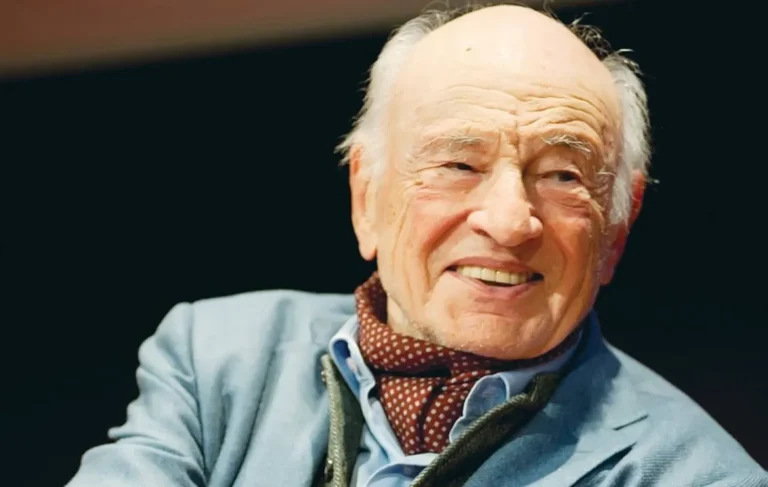
Paris, France – On Saturday, May 30, 2026, the eminent French philosopher and sociologist Edgar Morin passed away at the age of 104. He left behind a vast intellectual legacy that made him a spiritual “grandfather” of French culture. He also became one of the most prominent minds that contributed to shaping critical consciousness in the 20th and 21st centuries.
His wife, Sabah Abu Salam Moran, announced his death, affirming that “until his final days, he remained attentive to the world, to others, and to the great human questions that nourished his thought.” She added in her statement: “Today, the void he leaves is immense, but his courage, his loyalty to his ideals, and his rigorous moral character will remain with us.”
Interdisciplinary intellectual journey
Edgar Morin (whose original name was Edgar Nahum) was born in Paris in 1921 to Jewish parents of Greek origin.
Morin was known as a quintessential humanist. He didn’t confine himself to a single field, but rather combined philosophy, psychology, ethnography, and even biology. In doing so, he established a comprehensive approach to understanding human nature and the complexities of the modern age.
Internationally, his name became synonymous with the creation of “cinema verité” (cinema of reality) through his renowned documentary film “Chronicle of a Summer” (1961). This film revolutionized the documentary genre by posing simple yet profound existential questions such as “Are you happy?” to ordinary citizens, thereby revealing previously unseen social and political dimensions.
Ethical commitment until the very last moment
Morin was known as a free voice, having joined the French Resistance against Nazism during World War II after being a member of the Communist Party. He later left the party to become a symbol of skepticism towards ideological indoctrination.
Even in his later years, Morin remained active, expressing his views on contemporary issues, from climate change to the war in Ukraine, as well as his principled stance on the tragedy in Gaza. In this context, he was a vocal critic of Israeli policies, a position that had previously led to accusations of antisemitism against him. He defended himself against these accusations and was acquitted.
Global lament
Tributes poured in from across the political spectrum, a testament to his intellectual breadth. French President Emmanuel Macron described him as a “universal spirit” and “humanity personified.”
Political leaders and international institutions also paid tribute to him. UNESCO, for example, lauded his “immense philosophical legacy,” considering his intellectual journey “a roadmap for the future.” On the X platform, where he had some 220,000 followers, Morin continued to tweet in his elegant and thought-provoking style. In this way, his voice remained present in the public debate on issues of democracy, globalization, and the fate of the planet.
With Morin’s passing, France and the human family lose a voice that saw “complexity” as the key to understanding the world, and “humanity” as a goal that transcends all differences. While his body is laid to rest, his books—numbering in the dozens—will remain a lasting echo of an intellectual journey that never ceased striving to understand “what it means to be human.”