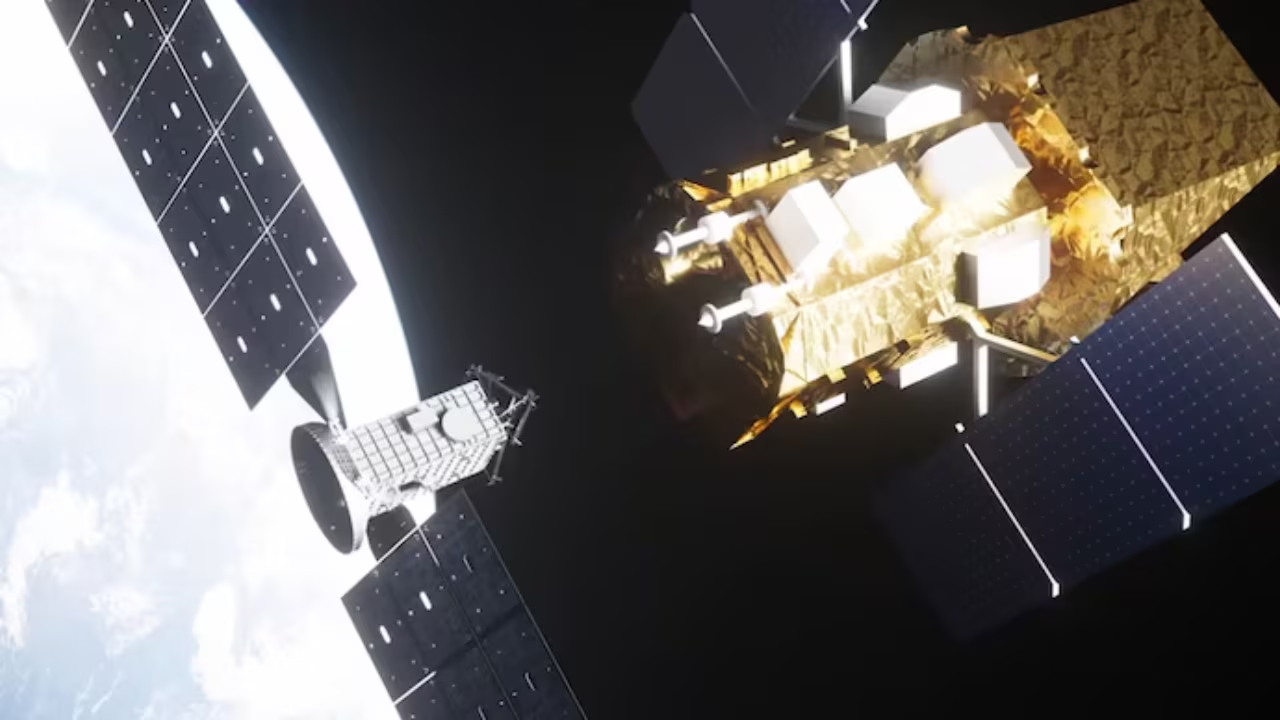
Washington, United States – The US space agency NASA is preparing to launch an unprecedented space mission lasting about a month, where it will send a specialized robot to reach a telescope currently operating in orbit. This qualitative operation aims to raise the telescope’s orbit to prevent its gradual fall towards Earth, which is occurring due to its constant friction with the upper layers of the atmosphere.
Advanced Orbital Maintenance Techniques
This mission is considered one of the most prominent orbital maintenance attempts that rely entirely on robotic vehicles. The robot will perform a series of precise maneuvers to dock with the telescope, followed by a carefully calculated push to raise the telescope to a more stable orbit. This procedure will allow the telescope to continue performing its scientific and research tasks for additional years without needing to be discarded
A Strategic Shift in Space Exploration
NASA confirmed that this mission reflects a new trend focusing on maintaining space assets instead of replacing them with new vehicles. This approach directly contributes to reducing the high costs of future missions and limits the risks associated with the accumulation of space debris and the re-entry of decommissioned satellites into the Earth’s atmosphere.
Scientific Importance of the Targeted Telescope
The targeted telescope is one of the vital scientific tools that has made significant contributions to understanding cosmic phenomena. Over the years, this observatory has succeeded in collecting accurate data about stellar explosions, black holes, and distant celestial bodies, making its preservation a top scientific priority for researchers at NASA.
New Horizons for Space Sustainability
Space experts believe that the success of this mission will mark a qualitative leap in orbital maintenance services, paving the way for similar operations to rescue other satellites and space observatories. Such steps will enhance the sustainability of infrastructure operating in space and extend its operational life, opening new horizons for exploring the universe more efficiently.