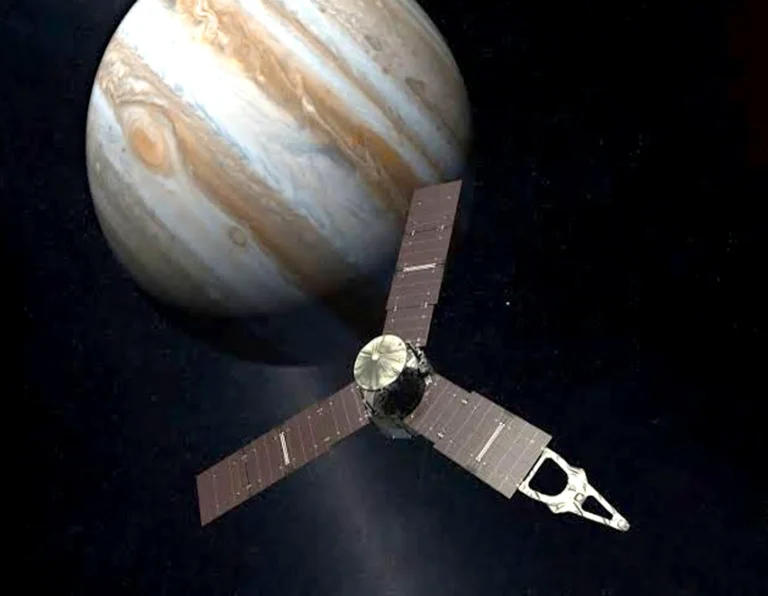
Washington, DC – NASA’s Juno spacecraft continues its scientific mission to uncover the secrets of Io, one of Jupiter’s most prominent and volcanically active moons in the solar system,
in an effort to understand what lies beneath its surface and how its interior feeds the hundreds of volcanoes that continuously erupt lava.
NASA scientists are analyzing data collected by the spacecraft during its close flybys of Io,
which provided high-resolution images and precise measurements of the moon’s internal structure.
This data helps researchers determine whether there is a layer of molten rock or a vast ocean of magma beneath the crust – hypotheses that have long fascinated planetary scientists.
Io is the most volcanically active celestial body
Io is known as the most volcanically active body in the solar system, boasting over 400 active volcanoes.
Some of these volcanoes erupt plumes of volcanic material hundreds of kilometers above its surface,
a phenomenon attributed to the immense gravitational pull of Jupiter and its neighboring moons,
which generates a constant internal heat.
Researchers confirmed that the new data will contribute to understanding the mechanisms of heat transfer within Io,
how volcanoes form and regenerate, and will also help explain the nature of geological
interactions on other celestial bodies subject to similar tidal forces.
New visions…and the development of scientific models
The Juno mission, launched in 2011 and reaching Jupiter’s orbit in 2016, is one of the most important planetary exploration missions in NASA’s history.
It successfully provided unprecedented information about Jupiter’s atmosphere, magnetic field,
and internal structure before expanding its mission to study several of its major moons, most notably Io.
Scientists believe that studying this moon will not only help in understanding its geological history
but may also offer new insights into how planets
and moons formed in the early solar system and contribute to developing scientific models
that explain volcanic activity on distant celestial bodies.
NASA hopes that future analyses of Juno’s data will reveal further details about Io’s internal structure,
helping to solve one of the greatest scientific mysteries: the immense energy source
that sustains this moon’s continuous volcanic activity for billions of years.