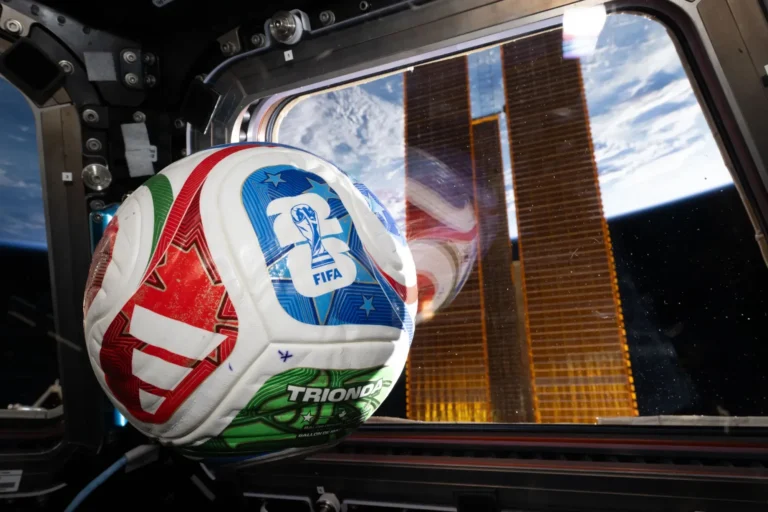
Washington, United States – In an innovative move blending the glow of sports achievement with the horizons of space exploration, NASA has unveiled a unique symbolic initiative: sending a soccer ball to the lunar surface if the US national team succeeds in winning the World Cup in the current edition hosted by the United States, Canada, and Mexico.
Linking Sports to Exploration Programs
This initiative comes as part of NASA’s ongoing efforts to link major mass events with its future lunar exploration programs under the ambitious “Artemis” project. According to the agency, the soccer ball would not be just a piece of sports equipment; it would be carried on a future lunar mission as a symbol of national athletic achievement if the US team manages to claim the title for the first time in history, making it one of the most distinctive sports items ever to reach the moon.
Wide Public Interaction
The idea has sparked significant interaction on social media. Many have praised this approach, describing it as an innovative way to promote space sciences, inspire younger generations, and connect them with science and technology through sports. Others see this initiative as a reflection of the great enthusiasm and momentum surrounding the US hosting of this global event, adding an exceptional historical character to the tournament.
The “Artemis” Project and Future Vision
NASA continues its intensive preparations to execute the “Artemis” missions, aiming to return astronauts to the lunar surface to pave the way for a sustainable human presence. These journeys are not limited to lunar exploration; they are a fundamental step in testing advanced technologies and life-support systems that will later be used for the ultimate human ambition: exploring Mars.
Employing Mass Events for Science
Observers note that combining sports and space reflects a growing trend toward utilizing events with massive public reach to boost interest in science. With hundreds of millions around the world following the World Cup, this initiative gains a global echo, giving NASA an unprecedented opportunity to reach wide segments of the global audience, reinforcing the image of space as a shared horizon for all humanity.