
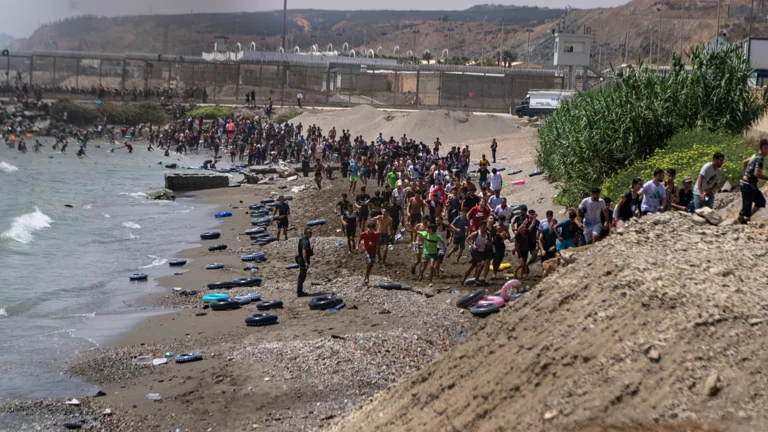
Madrid, Spain – Ceuta, the Spanish enclave in North Africa, is on high alert after thousands of people crossed from Morocco in an irregular manner, resulting in the deaths of at least 18 people, in a large human influx and an intense wave of irregular migration that began around July 30, 2026. Reports and videos on social media confirm that thousands of people have succeeded in crossing the border, with the number of participants in the main wave ranging between 1,500 and 3,000 people, who attempted to break through the border fence or swim around it using life jackets.
Thousands of people crossed the border from Morocco into Ceuta on Thursday afternoon without any checks, walking on land and then swimming across the breakwater that separates the border. Early morning was quiet and saw only a few dozen swimmers, but by midday the border was overflowing with Moroccans in a majestic scene; thousands entered, drenched in water as if celebrating a World Cup victory, hugging, asking for clean clothes to dry their phones, and cheering, while others carrying children continued on in search of a reception center.
Overwhelmed by the sheer number of people, the Civil Guard and emergency services could only provide first aid to the injured, while at least eighteen people died trying to reach the city. Late Thursday afternoon, the government mobilized army units already deployed in Ceuta to support the Civil Guard, and Prime Minister Pedro Sánchez traveled to the city on Friday.
The initial joy quickly fades upon the migrants’ arrival at the Temporary Immigrant Detention Center (CETI). Hundreds of young men wander aimlessly, unaware of what awaits them, asking passersby about the purpose of the wristbands they’ve been given, whether they can leave for the mainland, and when they’ll receive food or treatment for their swollen wrists. Garbage trucks arrive at the center, overflowing with waste and creating a potential health crisis. The gates remain closed, and a single tap provides the only means of showering. Exhaustion, doubt, and despair are etched on their faces, amidst the constant movement of police cars, Red Cross vehicles, and supply trucks heading up the center.
Humanitarian emergency and depletion of local shelter facilities
Faced with this immense human pressure, the mayor of Ceuta declared a comprehensive humanitarian and social emergency. The events resulted in severe overcrowding in reception facilities, particularly those designated for unaccompanied minors, forcing hundreds of migrants to sleep in the open. In its official response, the Spanish government announced the deployment of military reinforcements to support the Civil Guard and intensified coordination with Morocco to arrange repatriation operations, coinciding with a visit by Prime Minister Pedro Sánchez.
The truth about the figures circulating: Debunking social media exaggerations
While social media platforms circulated exaggerated figures claiming that 12,000 migrants were crossing per hour, bringing the total to 80,000, field reports and official statistics indicate that these claims are inaccurate. A local official stated that the peak crossing rate was approximately 200 people per minute (12,000 per hour), a short-term surge, not a continuous, round-the-clock influx.
These figures are inconsistent with Ceuta’s limited geographical area and capacity, and these cumulative estimates are based on secondary accounts and unverified reports. The Sánchez government did not portray the event as an existential threat to national security, but rather focused on a rapid operational response and cooperation with Rabat, while facing harsh criticism from the opposition demanding the declaration of a national state of emergency, all while awaiting official statements from the Spanish Ministry of the Interior.