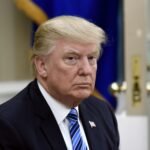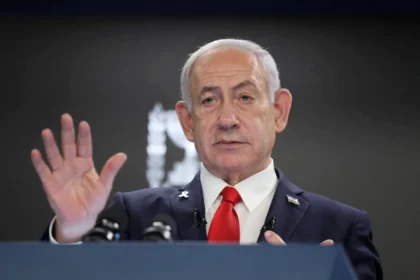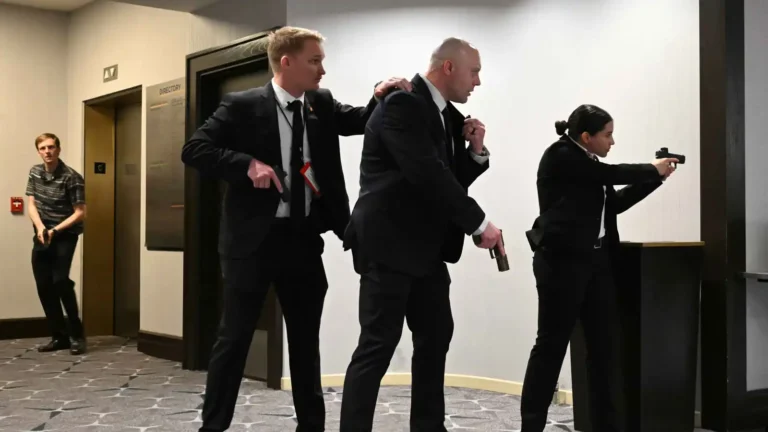
Washington, DC – In a scene reflecting escalating political tensions and a heightened security climate, US President Donald Trump held an emergency press conference at the White House following the horrific shooting that occurred Saturday night during the White House Correspondents’ Association dinner at the Washington Hilton Hotel. In a defiant tone, Trump asserted that the attack would not alter his foreign policy course, particularly regarding the ongoing confrontation with the Islamic Republic of Iran.
A moment of unity amidst the bullets
President Trump began by praising the role of the Secret Service and law enforcement in controlling the situation. He said, “This Secret Service-run event was fundamentally about freedom of speech, and it was supposed to bring members of both parties and the press together under one roof.” He added, noting an unexpected irony, “To some extent, it achieved that goal because it actually united everyone in that difficult moment. I saw a completely united room, and it was truly wonderful to see that unity in the face of such a difficult situation.” Trump then described the details of the attack, stating that a man armed with multiple weapons attempted to breach a security checkpoint but was met with a firm response from “brave members of the Secret Service” who were able to subdue him with remarkable speed. The president commended the officers’ professionalism, emphasizing that their swift action prevented a major massacre.
The war with Iran and the president’s position
In a clear political message, Trump stressed that he did not believe the shooting was related to the ongoing military operations against the Islamic Republic, but he used the incident to emphasize the firmness of his position, saying: “This attack will not prevent me from achieving final victory in the war against Iran. We are continuing on our path, and we will not be intimidated by these attempts, whether individual or organized.”
Cole Allen: A close examination of the “lone wolf” striker’s biography
While Trump was speaking from the White House podium, federal teams were racing against time in California. Law enforcement had identified the suspect as Cole Allen, a 31-year-old resident of Torrance, California. According to security sources, Allen acted alone and was found to be carrying a small arsenal that included two firearms and several knives. Jason Pack, a retired FBI special agent supervising the case, explained that investigators now have a comprehensive picture of Allen’s life. “In cases like these, the suspect’s name becomes the key to every government database,” Pack told reporters. “We’re talking about a thorough examination of his criminal record, his military service, his mental health indicators, and even his travel and contact history.” Pack emphasized that the intelligence process of reconstructing the suspect’s life takes only minutes. As agents surrounded his Torrance home awaiting search warrants, federal software sifted through his emails, social media accounts, and internet search history. Pak considered that “the physical place where a person lives is like an autobiography,” predicting that the belongings inside the house, such as diaries or correspondence, would reveal the true motive behind the attack.
Injuries and security confrontation
The incident resulted in a Secret Service agent being struck by a bullet that lodged in his protective vest, saving his life. The agent is currently receiving treatment for injuries described as “non-life-threatening.” This security breach has sparked a broader discussion about security vulnerabilities at major hotels that host presidential events.
The White House Ballroom: Trump’s Controversial Project
President Trump seized on the incident to renew his long-standing and controversial call for a secure, private ballroom within the White House. He described the Washington Hilton as insufficiently secure for events of this scale, promoting his proposal for a 90,000-square-foot ballroom equipped with reinforced materials and advanced security technology. This project, intended to replace the historic East Wing and accommodate 650 guests, faces significant legal and political hurdles. While supporters view it as a necessary, privately funded security upgrade, opponents and critics see it as an eyesore of the historic complex and an unjustified expense. Trump argues that the absence of a dedicated ballroom within the White House leaves the president and guests vulnerable to risks that could be mitigated in a building specifically designed to withstand armed threats. As federal investigations continue in California and Washington, the nation’s capital remains on high alert. Trump’s insistence on linking his ability to confront external adversaries like Iran to his resolve in the face of domestic violence places the incident within a political context that transcends a mere security breach. While authorities acknowledge that Cole Allen may represent a “lone wolf” pattern, the question remains as to how this attack will affect election security strategies and major political events in the coming days.