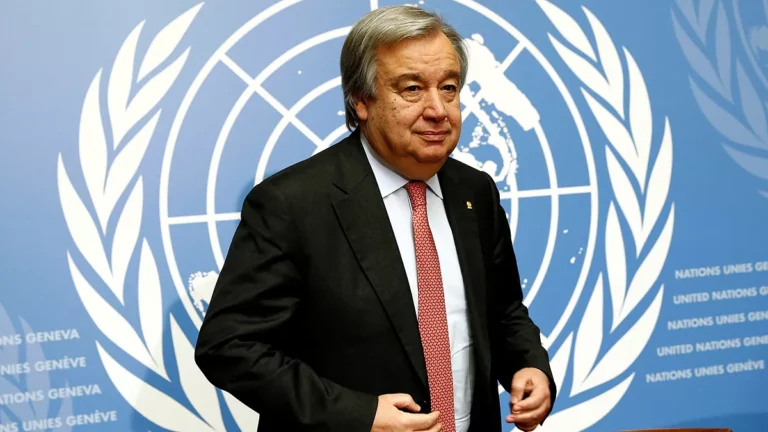
Washington, DC – UN Secretary-General António Guterres expressed his deep concern over the recent escalation and restrictions on navigation in the Strait of Hormuz. He emphasized that this strategic waterway is a vital artery for the global economy and its disruption cannot be tolerated. These remarks were made by his spokesperson, Stéphane Dujarric, who conveyed Guterres’s insistence on the full restoration of international navigation rights and the need to respect the laws governing them.
Concern over “intense activity” and maritime accidents
In a press briefing reported by Al Jazeera, Dujarric explained that the Secretary-General is following with great concern the “intense activity” and “confusion” that has prevailed in the waterway over the past 48 hours.
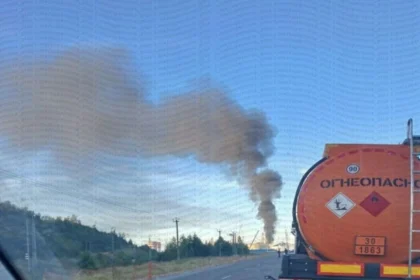
He noted that the recent series of maritime incidents is exacerbating regional tensions. He also emphasized that freedom of navigation in the Strait of Hormuz “is not an option, but an international principle that must be respected by all parties without exception.” These warnings come at a time of heightened security instability in the Strait, through which approximately one-fifth of the world’s oil consumption passes. This instability has also disrupted the flow of commercial vessels and energy tankers, raising fears of a wider confrontation that could destabilize the region.
Painful economic and humanitarian repercussions
The UN’s warnings were not limited to security concerns but extended to severe economic repercussions.
Dujarric drew attention to the significant increase in the prices of oil, fertilizers, and urea as a result of the blockade and restrictions. He explained that this increase directly and profoundly impacts the capabilities of UN relief agencies, particularly regarding the planning, procurement, and logistics of humanitarian aid destined for developing countries and disaster-stricken areas.
Protection of civilians and infrastructure
In a related context, the spokesperson for the Secretary-General reiterated the UN’s principled stance on conflicts, emphasizing that “no military objective, regardless of its nature, justifies the widespread destruction of civilian infrastructure or the deliberate infliction of harm on civilian populations.”
He considered the obstruction of waterways upon which people depend for food and energy to be an unacceptable form of pressure that violates international conventions. The United Nations renewed its call on all actors in the region to exercise restraint and prioritize diplomacy. It also called for ensuring that the Strait of Hormuz remains a safe and open waterway for global trade, free from military and political tensions, in order to avert an economic catastrophe whose repercussions could disproportionately affect the world’s poorest people.