Beirut, Lebanon – The issue of Hezbollah’s weapons has returned to the forefront of the Lebanese political scene, with Foreign Minister Youssef Raji confirming that the government is proceeding with a plan aimed at confining weapons to the hands of the state, considering that the top priority is disarming the party. This coincides with the start of implementing new security arrangements in southern Lebanon following President Joseph Aoun’s visit to Washington, which gave a boost to the US-sponsored process for the redeployment of the Lebanese army and the withdrawal of Israeli forces from specific areas.
In an interview with Le Journal du Dimanche, Regi said that Hezbollah is “Lebanese in name, but Iranian in essence,” considering that the nature of the party transcends the national framework, in reference to its ideological and political ties to Iran, and stressing that dismantling its military structure represents the basic entry point for the Lebanese state to regain its legitimate monopoly on force.
The Lebanese foreign minister’s remarks come at a time when Hezbollah is holding on to its weapons, asserting that it represents a “Lebanese resistance movement” against the ongoing Israeli occupation of parts of southern Lebanon, a position that presents the government with complex political and security challenges amid internal divisions over the future of the party’s weapons.
Field progress and implementation of the “framework formula”
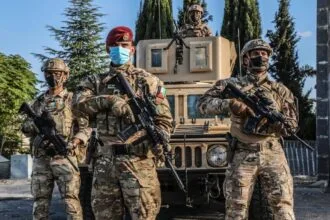
Raji linked President Joseph Aoun’s visit to the United States to the progress achieved in implementing the so-called “framework agreement,” emphasizing that the visit helped break the deadlock surrounding this issue and allowed for the launch of the first phase of the agreement’s implementation in the pilot areas. In this context, the Lebanese Army announced the start of its deployment in the town of Zawtar al-Gharbiya in the Nabatieh district, located south of the Litani River, as it is the first area covered by the initial phase of the agreement signed in Washington on June 26. This agreement stipulates a gradual Israeli withdrawal from Lebanese territory in exchange for the army assuming responsibility for security and disarming armed groups in those areas.
He stressed that the Lebanese government had made a clear decision about a year and a half ago to consider all military operations carried out by Hezbollah as illegitimate, after its military activity had been overlooked in previous stages, noting that the government is determined to restore the state’s authority over all Lebanese territory.
General mood and military capabilities
He added that the issue of Hezbollah’s transformation into a civilian political party remains its own affair, but the state’s priority is to end the presence of any armed force outside official institutions. He considered the state’s regaining its monopoly on weapons a fundamental condition for restoring stability and establishing the rule of law. He observed that public sentiment within Lebanon is undergoing a gradual shift, emphasizing that the overwhelming majority of Lebanese, including a growing number of Shiites, now support the state’s monopoly on weapons, after many had previously avoided expressing this position publicly for security reasons.
He also stated that the Lebanese army currently possesses the necessary capabilities to carry out its duties, noting that Hezbollah has suffered a significant weakening of its military capabilities in the recent period, and that its possession of ballistic missiles no longer represents the main challenge facing the state, as any potential confrontation will not be related to this type of weapon.
The American role and internal balances
Regarding the American role, Raji stressed that Washington remains the party most capable of exerting pressure on Israel, which prompted Lebanon to welcome its mediation in implementing the “framework formula,” adding that the United States exerted pressure on the Israeli side and obtained official assurances that Tel Aviv does not seek regional ambitions within Lebanese territory.
Raji’s statements reflect a clear escalation in the Lebanese government’s rhetoric toward Hezbollah, and also indicate an official move to restructure the security landscape by strengthening the army’s role as the sole entity authorized to bear arms. However, the success of this approach will remain contingent on the government’s ability to manage internal balances and the extent to which the parties involved adhere to security agreements, especially given Israel’s continued military presence in parts of southern Lebanon and Hezbollah’s ongoing insistence on retaining its weapons as an integral part of the “resistance” equation.