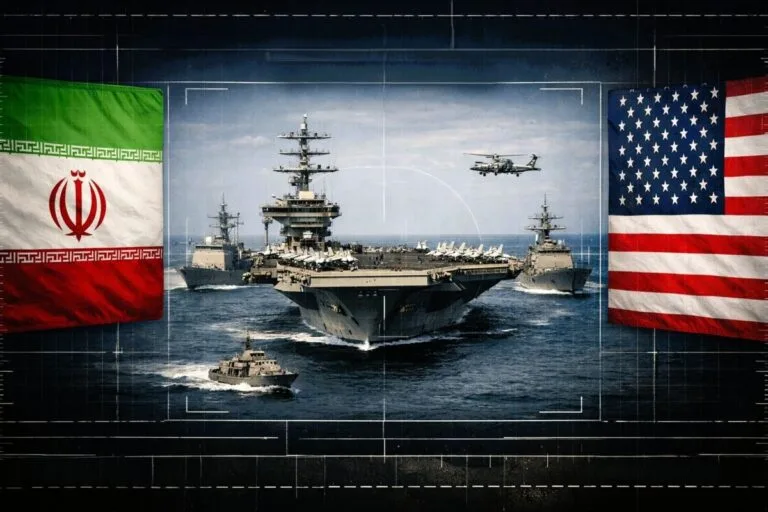
Tehran, Iran – In a significant escalation that threatens to take the confrontation between Washington and Tehran to a new level of economic and logistical tension, the Iranian news agency Fars published a report on Saturday asserting that the recent US airstrikes targeting railway infrastructure inside Iran warrant a direct response. This response could target vital commercial hubs in the region, including the Jebel Ali port in the UAE and the port of Haifa in Israel.
Background to the targeting: A strike on commercial infrastructure
This threat comes in the wake of a US airstrike on July 9, 2026, targeting the strategic Aq Tekeh Khan Bridge in the Aq Qala region of Golestan Province in northeastern Iran. This bridge is a vital part of a railway network connecting Iran to extensive regional transport networks that extend to China and Russia via Turkmenistan and Kazakhstan. It is also a key component of the Belt and Road Initiative.
Observers believe the US targeting was not random, but rather aimed at undermining Iran’s logistical role as a corridor linking East and West. This comes as an attempt to disrupt trade flows and reduce Tehran’s influence in international supply chains, especially given the maritime restrictions already imposed on Iranian shipping.
“The War of the Corridors” and the Pivot Points
According to security analyses, this conflict is fundamentally about trade routes; the India-Middle East-Europe (IMEC) corridor—which connects India to the Gulf, then Israel, and finally Europe—is seen as a strategic competitor to routes passing through Iranian territory. Based on this perspective, assessments cited by the agency suggest that an Iranian response, should it escalate, may not be limited to conventional military confrontations. It could extend to targeting ports that serve as hubs in competing trade networks, specifically Jebel Ali Port in the UAE and Haifa Port in Israel.
Warnings of international repercussions
These developments are raising serious concerns within the international community about the stability of global supply chains. While the confrontation was largely confined to maritime traffic within the Strait of Hormuz, the rules of engagement appear to have shifted to include economic infrastructure. Experts warn that expanding the conflict to encompass ports and trading hubs will have dire consequences for international trade. This development puts the entire region on edge and increases the likelihood of a direct confrontation between Washington and Tehran escalating to unprecedented levels.