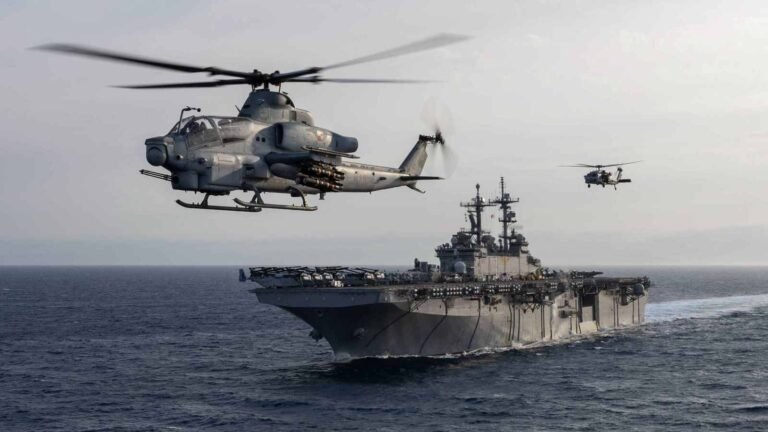
Washington, DC – The Persian Gulf region experienced a night of unprecedented military tension as US forces and the Iranian Revolutionary Guard Corps exchanged direct fire. This escalation has brought the region to the brink of open regional conflict.
These developments followed the official announcement by US Central Command (CENTCOM) that its forces had countered intense Iranian attacks targeting international shipping lanes in the Strait of Hormuz and neighboring Gulf states.
Confrontation in shipping lanes
The US Central Command announced via its official X platform that its forces successfully intercepted a group of Iranian ballistic missiles and drones.
CENTCOM explained in a statement that the operation began with the downing of four Iranian suicide drones that were heading toward the Strait of Hormuz. It described them as a “direct threat” to regional maritime navigation.
In response to these provocations, U.S. forces conducted precision airstrikes targeting Iranian coastal surveillance radar sites on the islands of Gorakh and Qeshm. The objective was to neutralize capabilities supporting attacks against commercial vessels. Initial U.S. assessments indicated that forces intercepted six of the seven ballistic missiles launched by Iran toward Kuwait and Bahrain. The seventh missile failed to reach its intended target, the assessment confirmed.
Gulf state of alert and sirens sounding
Simultaneously with the missile attacks, Kuwait and Bahrain experienced a tense night as Kuwaiti air defenses intercepted hostile aircraft. The Kuwaiti Army General Staff explained that the sounds of explosions heard in various areas were the result of successful interceptions by air defense systems. In Bahrain, the Ministry of Interior activated air raid sirens and urged residents to remain calm and seek shelter as a precautionary measure.
The Revolutionary Guard acknowledges the attack and issues a threat.
For its part, the Iranian Revolutionary Guard’s public relations department claimed responsibility for targeting what it described as “enemy bases” in the region.
A statement issued by the Revolutionary Guard and broadcast on Iranian state television said that US bases in both Kuwait and Bahrain were subjected to missile and air strikes in retaliation for US attacks on sites on Iranian islands.
The toll of previous attacks and the humanitarian impact
This escalation follows a series of deadly attacks on Kuwaiti soil last Wednesday. The Kuwaiti Ministry of Health revealed the horrific details, stating that the Iranian aggression resulted in injuries to at least 63 people, including travelers and employees at Kuwait International Airport.
The ministry explained that the injuries ranged from multiple fractures and amputations to head injuries and brain hemorrhages, in addition to cases of smoke inhalation resulting from the targeting of vital facilities. The attack also claimed the life of an Indian resident.
The American position and the coming ambiguity
In closing, U.S. Central Command (CENTCOM) categorically denied Iranian claims of damage to the U.S. Fifth Fleet headquarters in Bahrain, calling them “lies.”
CENTCOM affirmed that its forces remain on high alert. It also emphasized its full readiness to continue responding to what it described as unprovoked Iranian aggression, in self-defense and to protect vital U.S. interests and allies in the region. This comes amid growing international concern about the repercussions of this escalation on global energy supplies and the security of maritime routes.