Washington, DC – In a firm tone reflecting Washington’s dual strategy of military pressure and diplomacy, US Defense Secretary Pete Hegseth affirmed that the US naval blockade of Iran remains in place with “absolute rigor.” At the same time, he emphasized that US forces are on high alert and ready to resume military intervention should the ongoing peace talks fail.
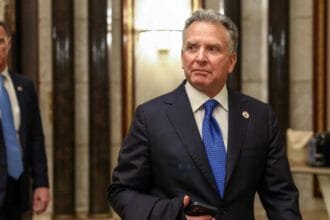
Hegseth’s remarks came during a press conference held at the US Embassy in Singapore, on the sidelines of the conclusion of the Shangri-La Dialogue, the Asian security conference. The Secretary explained that maritime security in the Strait of Hormuz was a key topic in his bilateral discussions during the conference. He affirmed Washington’s commitment to ensuring the strait remains “an open and free waterway that the entire world can use without restrictions.”
A merchant ship was neutralized in the Gulf of Oman.
In conjunction with these statements, the US Central Command (CENTCOM) translated this resolve into action on the ground. It announced a military operation against a Gambian-flagged merchant vessel attempting to sail toward an Iranian port. CENTCOM explained in an official statement that the ship was detected transiting international waters in the Gulf of Oman, heading toward Iran. After issuing more than 20 warnings against violating the imposed naval blockade, US forces were compelled to “neutralize” the vessel with a missile. This forced it to change course, and no casualties were reported.
The fate of the rules and the course of negotiations
In response to questions about the possibility of withdrawing US troops from their bases in the Middle East that have been targeted by previous Iranian attacks, Secretary Higseth left the final decision to President Donald Trump. He explained that this step would depend directly on the outcome of the peace negotiations. He added, “Our focus right now is on maintaining a high state of readiness and being fully prepared to intervene again if necessary.”
The stance on China and Taiwan
In a parallel development, Secretary Higseth addressed regional tensions in the Pacific, emphasizing that the US position on Taiwan remains unchanged, despite Washington’s acknowledgment of a significant Chinese military buildup. These remarks corroborated President Trump’s earlier statements regarding discussions about arms sales with Chinese President Xi Jinping. In this context, the issue of Taiwanese armament remains subject to Trump’s policy of “strategic ambiguity.”
In conclusion, regarding international security alliances, Higseth affirmed the United States’ commitment to the OCAS agreement, including the sale of Virginia-class nuclear submarines to Australia. Despite domestic skepticism about the deal’s ability to provide effective deterrence against China’s growing naval influence, it remains central to the global balance of power equation.