Tehran, Iran – As the open military confrontation between Iran on one side, and the United States and Israel on the other, entered its seventh day, Iranian cities awoke on Friday to the most intense wave of airstrikes yet, targeting strategic centers and residential areas. Meanwhile, Western intelligence and military reports assert that the offensive is achieving results “exceeding expectations.”
Hell over Tehran and Isfahan: Residential neighborhoods targeted
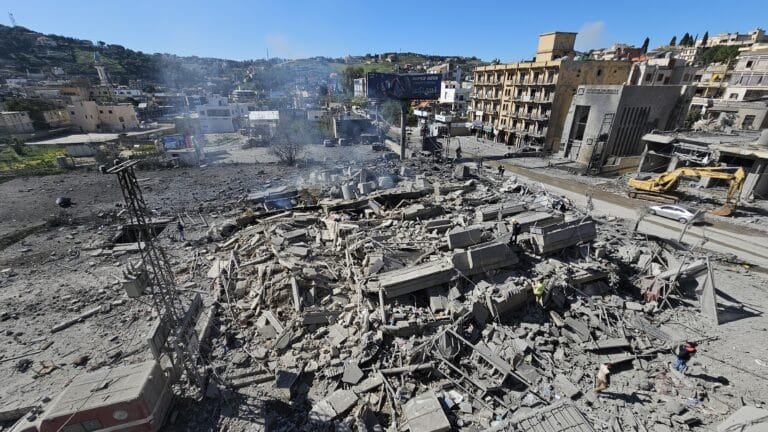
Iranian state media reported a series of intense airstrikes since dawn on Friday. According to the Tasnim news agency, the heavy bombardment focused on areas in the heart of the country, specifically around the strategic city of Isfahan. The agency stated that three small towns on the outskirts of Isfahan were subjected to successive air raids. Massive explosions were reported in the eastern part of the city, resulting in civilian casualties and significant damage to residential buildings and vehicles. In the capital, Tehran, home to some 15 million people, residents endured a terrifying night, with eyewitnesses describing the drone of warplanes flying at extremely low altitudes over rooftops. This triggered widespread panic. Moving south, the Iranian Students’ News Agency (ISNA), citing the Qom governor’s office, confirmed that two military bases outside the holy city were targeted. It indicated that the damage was limited to military infrastructure, with no casualties reported so far.
Tel Aviv: “The results are better than we imagined.”
From the Israeli side, an air of absolute confidence prevailed regarding the progress of the operations. A senior Israeli official told The Times of Israel on Friday (March 5) that the joint military campaign with the United States against the Islamic Republic was proceeding “much better than expected.” The official added, “No one expected such success so quickly. Although there is still a long way to go and much work to be done, the achievements on the ground so far are significant and are redrawing the map of power in the region.”
US Central Command: Neutralizing the missile and drone arsenal
Meanwhile, Admiral Brad Cooper, commander of U.S. Central Command (CENTCOM), revealed shocking figures reflecting the extent of the damage inflicted on the Iranian military machine. Cooper announced that U.S. forces had attacked nearly 200 targets inside Iran in the past 72 hours. This has significantly weakened Tehran’s missile capabilities and drone program.
Cooper explained the details of the special operations, saying:
B-2 Strikes: In the past hour alone, B-2 stealth bombers conducted surgical strikes, dropping dozens of armor-piercing bombs (weighing 900 kg). The bombs targeted ballistic missile launch sites buried deep underground and in underwater facilities. Air Command Impairment: The Iranian Aerospace Command was directly targeted, an action Cooper described as “an act that undermines Iran’s ability to threaten U.S. interests.” Regarding the Decline in Offensive Effectiveness: Admiral Cooper confirmed, in numerical terms, that Iranian ballistic missile attacks have decreased by 90%. Drone attacks have also declined by 83% compared to the first day of the conflict.
Destruction of production infrastructure
Washington did not stop at striking launch sites; it moved to a phase of “industrial eradication.” Cooper confirmed that the US military is now working to destroy the infrastructure dedicated to missile production inside Iran, to ensure the regime cannot compensate for its losses in the short or medium term. This wave of airstrikes presents the Iranian regime with difficult choices. This is happening amidst a suffocating air and technological blockade, and a US-Israeli technological superiority that, within a single week, neutralized the majority of the deterrent force that Tehran has boasted about for decades.
As the bombing of vital facilities and Revolutionary Guard bases continues, the region awaits what the coming hours will bring, amid fears of a wider conflict or broader security collapses deep inside Iran.