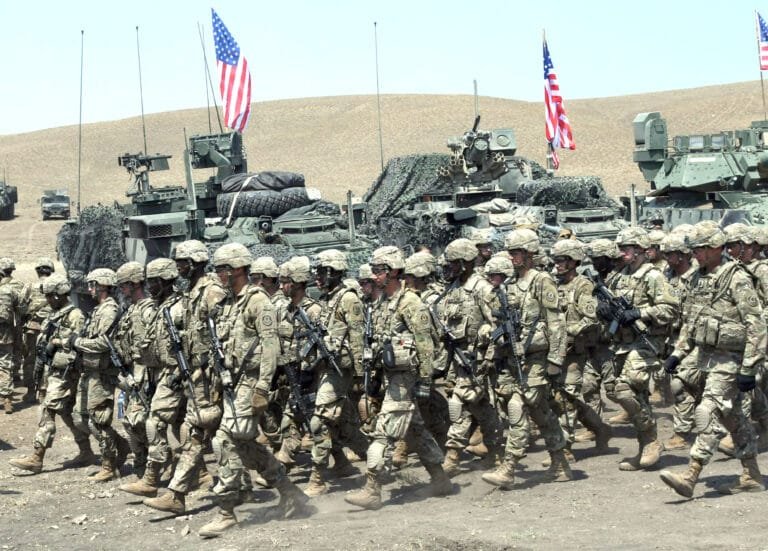
Washington, DC – In a silent but strategically significant move, Fort Liberty in North Carolina has witnessed a development that has raised concerns among military observers: the US Army has abruptly canceled key training exercises for the 82nd Airborne Division’s command post.
- The 82nd Division: Washington’s Flying Dagger
- Scenario 1: “Bridgehead” and the takeover of airports
- Scenario 2: “Nuclear Cleansing Operations”
- scenario 3: Protecting “Gulf security” and regional deterrence
- scenario 4: “Securing the capital” and the post-fall vacuum
- Challenges of the “Iranian quagmire”: Why the hesitation?
- The shift from “punishment” to “subjugation”
This action, revealed by The Washington Post, is not interpreted in military terms as an administrative glitch. Rather, it is seen as a signal of heightened alert.
In US military doctrine, the suspension of command post training specifically signifies that the unit is now “on duty” for an imminent and genuine mission. This raises the most pressing question since the launch of Operation Epic Wrath on February 28: Is a ground invasion imminent?
The 82nd Division: Washington’s Flying Dagger
To grasp the gravity of the situation, one must understand the nature of the 82nd Airborne Division. It is not merely an infantry formation; it is the United States’ “Immediate Response Force” (IRF). This division is designed to be able to deploy thousands of paratroopers and their equipment to any point of conflict on Earth within just 18 hours of a presidential order.
It is a force that requires no clearance or lengthy logistical preparation; it drops from the sky, seizes the ground, and shifts the balance of power before the enemy can comprehend the magnitude of the shock.
The cancellation of its exercises today, coinciding with the escalating conflict with Iran, indicates that American military planning has shifted from a phase of “air destruction” to one of “physical control.” Therefore, what scenarios might lead the US military to send its soldiers into Iranian soil?
Scenario 1: “Bridgehead” and the takeover of airports
This scenario is the most likely and consistent with the 82nd Airborne Division’s specialization.
The objective here is not to occupy major Iranian cities, but rather to conduct swift landing operations to seize vital military airfields, particularly in southwestern Iran (Ahvaz) or areas near the Iraqi border.
Why airfields? Because controlling an Iranian airfield and converting it into a “forward operating base” (FOB) provides US and Israeli aircraft with closer launch points and allows for the flow of logistical supplies without the need to travel long distances from bases in the Gulf or Jordan.
Therefore, this scenario aims to create “buffer zones” within Iranian territory that can be used as platforms to further dismantle what remains of the Islamic Revolutionary Guard Corps (IRGC).
Scenario 2: “Nuclear Cleansing Operations”
Although US and Israeli airstrikes have achieved precise hits on nuclear facilities, “destruction from the air” does not guarantee the complete neutralization of the nuclear threat.
The Pentagon fears that the Iranian regime, in its final moments, might smuggle its stockpile of enriched uranium (estimated at 440 kg) to secret caches or deliver it to terrorist organizations.
This underscores the need for a “surgical” ground intervention. The scenario involves deploying special forces, supported by paratroopers from the 82nd Airborne Division, to secure sites like Natanz or Fordow.
This would allow teams of nuclear technicians from the US Department of Energy to physically enter, dismantle the remaining centrifuges, and remove the fissile material under heavy guard.
Therefore, this task cannot be accomplished by F-35s, no matter how precise they may be.
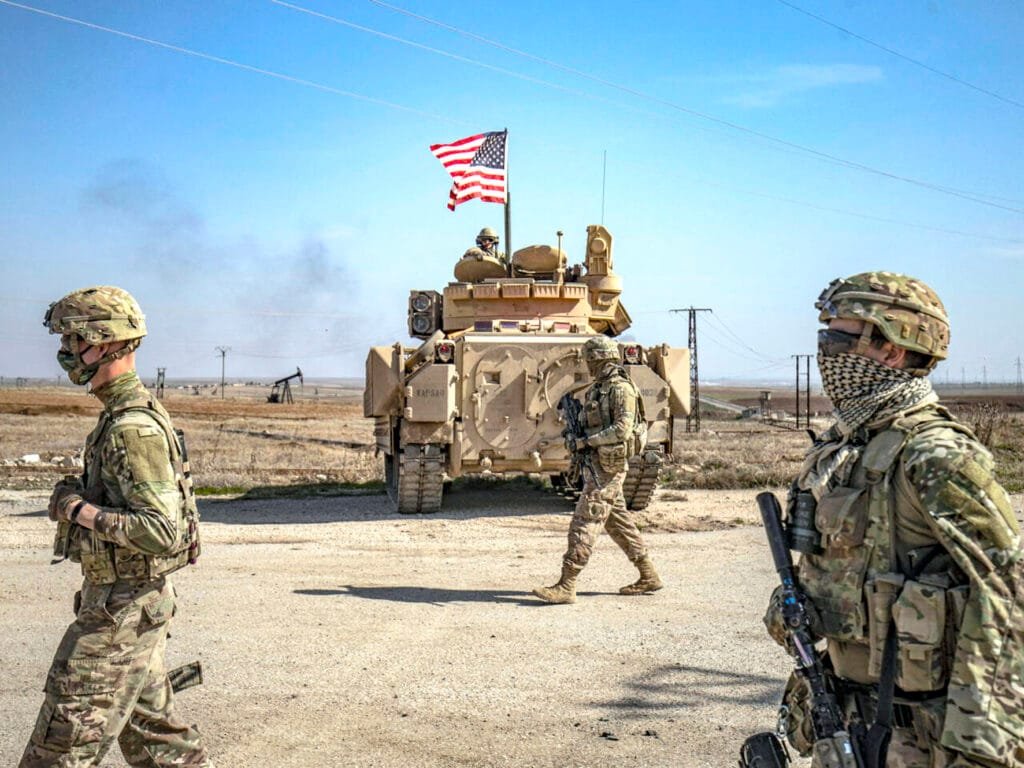
scenario 3: Protecting “Gulf security” and regional deterrence
With six U.S. service members killed so far, and attacks on energy facilities in Fujairah, Qatar, and Saudi Arabia escalating,
elements of the 82nd Airborne Division may be deployed not inside Iran, but as a “deterrent force” in neighboring countries.
This scenario envisions deploying ground combat units to vital oil fields and strategic ports (such as the port of Fujairah
and the Ras Laffan complex) to bolster local defenses against any ground infiltration or sabotage attempts by IRGC sleeper cells.
The presence of U.S. paratroopers on the ground at these locations would send a “final deterrent” message
to Tehran that any further disruption to global energy supplies would be met with an immediate ground response.
scenario 4: “Securing the capital” and the post-fall vacuum
This is the “worst-case scenario.” Given reports of the Supreme Leader’s assassination and the collapse of the leadership structure in Tehran,
the international community could find itself facing a failed state whose Revolutionary Guard possesses chemical and biological weapons and rogue militias.
In the event of a sudden regime collapse, Washington might be forced to rapidly deploy “stabilization forces”
to secure the centers of power in Tehran and protect embassies and diplomatic missions.
Furthermore, there would be the imperative to prevent weapons of mass destruction from falling into the hands of extremist groups.
This scenario mirrors the 2003 invasion of Baghdad, but with a “rapid deployment” approach to avoid
a protracted war and to quickly hand over power to a “transitional council” (possibly led by Reza Pahlavi, as some speculate).
Challenges of the “Iranian quagmire”: Why the hesitation?
Despite the 82nd Airborne Division’s high level of readiness, the “boots on the ground” decision faces formidable obstacles:
The harsh geography: Iran is not the open plains of Iraq; it is a land of rugged mountains (the Zagros and Alborz)
that form natural strongholds, making ground operations a logistical nightmare.
The suicidal doctrine: The Pentagon is aware that the Revolutionary Guard has trained for decades in guerrilla warfare
and suicide operations against invading forces, which could raise the number of American casualties
to a level unacceptable to public opinion in Washington.
The political trap: President Trump, despite his hawkish rhetoric, built his political career on the idea of ”ending endless wars.”
Conversely, involvement in a ground invasion of Iran could undermine his campaign promises and transform him
into a traditional “war president,” something he is trying to avoid by pressuring for unconditional surrender.
The shift from “punishment” to “subjugation”
The cancellation of exercises at Fort Liberty is the clearest indication yet
that the US leadership is no longer content with merely “punishing” Iran from the air,
but is now preparing for a scenario of “subduing” it on the ground should it refuse the terms of surrender.
The air campaign has accomplished much; it has destroyed 90% of the missiles and crippled 83% of the drones,
but “total victory” in the military lexicon is only achieved when infantry soldiers seize the enemy’s command headquarters.
The 82nd Airborne Division now stands in a “gray zone” between readiness and execution.
If the orders are given, the next 18 hours could change the face of the Middle East forever.
The ball is now in Tehran’s court; either accept the “poisoned chalice” and unconditional surrender,
or await the paratroopers who may land at Pasteur or Natanz before sunrise tomorrow.