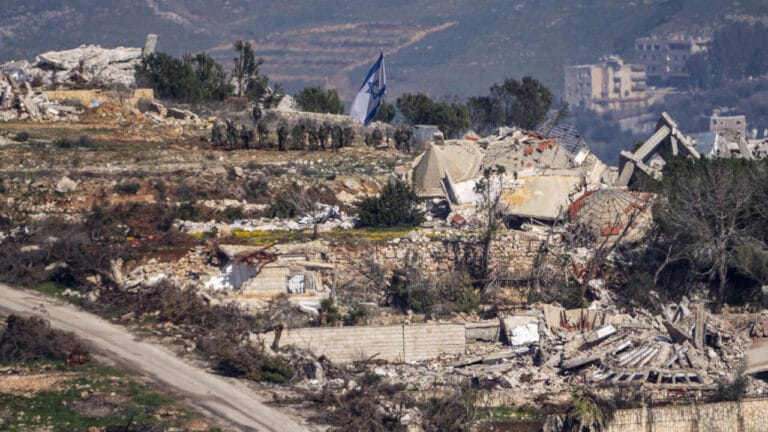
Beirut, Lebanon – Recent hours have witnessed media and political confusion following conflicting statements from American, Lebanese, and Israeli sources regarding the extent of Israel’s partial withdrawal from areas it recently seized in southern Lebanon. This confusion comes as the fifth and final round of indirect negotiations is underway in Washington. These negotiations aim to end the fighting between Israel and Hezbollah.
An American narrative clashes with regional denial
A U.S. State Department official surprised many by announcing that Israel had taken a “concrete step” by withdrawing from parts of the territory it controlled in southern Lebanon. He described this as “a strong demonstration of good faith toward the legitimate Lebanese government.” He also called on the Lebanese army to deploy to those areas immediately.
However, this statement was met with a firm denial from the parties directly involved on the ground. In Tel Aviv, the Israeli Broadcasting Corporation confirmed that the army had not withdrawn from any area. The corporation emphasized that the political leadership had not issued any directives in this regard. In Beirut, a high-ranking Lebanese security official confirmed that his country “knows nothing” about any withdrawal from the so-called “buffer zone.” He indicated that the occupying forces remain stationed in their positions.
Dimensions of the negotiations in Washington
The negotiations are taking place in Washington through two working groups, one political and one military. It is likely that the Israeli delegation is attempting to demonstrate a “positive gesture” to the international community by leaking news of the withdrawal. This appears to be an effort to pressure the Lebanese delegation and accuse it of obstructing the talks.
According to reports from Israel’s Channel 12, the proposal under consideration includes an Israeli withdrawal from a specific “test zone.” This zone is likely located south of the Litani River, specifically south of the “Yellow Line.”
An Israeli source indicated that the delegation might present detailed maps to delineate this area, which would be subject to “partial decontamination.” The Lebanese army would administer the zone under direct American supervision.