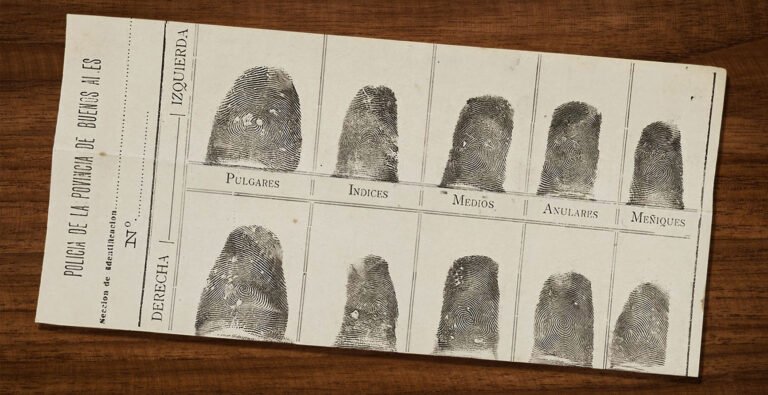
Buenos Aires, Argentina – A historical criminal case in Argentina has shed light on one of the most significant milestones in the evolution of forensic science, as it was one of the first cases to rely on fingerprints as conclusive evidence to prove a crime and identify a perpetrator.
A Radical Shift in Investigation Methods
Dating back to the early 20th century, this case occurred at a time when Argentine judicial and security apparatuses were striving to move beyond traditional methods. Prior to this, reliance was placed entirely on testimonies, confessions, and circumstantial clues; however, the introduction of modern scientific techniques sparked a revolution that fundamentally altered the course of criminal justice.
The Fingerprint as a Unique Human Identifier
Historical sources in forensic medicine indicate that this case served as a practical test for the theory that “a fingerprint represents a unique identity that does not repeat between individuals.” The success of this test bolstered scientific confidence in this type of evidence and paved the way for its subsequent global adoption as a legal standard in judicial systems.
Establishing a Scientific Methodology for Justice
The success of using fingerprints in that case helped establish a rigorous scientific methodology within criminal investigations. Collecting and analyzing physical evidence became a core element in reaching judicial verdicts, reducing reliance on non-material evidence that could be prone to error or bias.
From Fingerprints to DNA
Over the decades, the use of forensic evidence evolved beyond traditional fingerprints to include more sophisticated techniques such as DNA analysis and digital forensics. These advancements have dramatically increased the precision of investigations and significantly contributed to reducing the likelihood of judicial errors.
Science as a Partner to the Judiciary
Criminology experts view this event not merely as a passing criminal case, but as the beginning of a “scientific revolution” in investigative techniques. It paved the way for science to become a primary partner to the judiciary and established a new era of trust in physical evidence as a reliable means to prove facts in court.